A good beach shelter should provide more than sun protection—it should stay secure when coastal breezes pick up, set up without a struggle, and pack down reasonably well for the trip home.
We’ve gathered 10 wind-resistant beach tents and canopies for different needs, from compact two- to four-person shade to spacious family shelters with side walls, sandbags, and adjustable coverage.
Best 10 Wind Resistant Beach Tents Picks for 2026
Best Family Cabana

- 43 sq. ft. of UPF 50+ shade
- Four 35-lb sand pockets for stability
- Folds to about 3 ft. 2 in.
Best For: Families wanting roomy, open beach shade
Best Pop-Up Shelter

- Instant one-person setup
- Five sandbags plus stakes and wind ropes
- UPF 50+ with mesh ventilation and privacy door
Best For: Families wanting enclosed, ventilated beach shelter
Best Adjustable Cabana
6.5-Foot Adjustable Beach Cabana

- Height adjusts from 6.5 to 7.5 ft.
- Multiple sandbags and spiral anchors
- Removable curtain and top ventilation
Best For: Groups needing flexible, structured shade
Best Wind-Powered Shade

- Wind-powered canopy works with breezes from 3 mph
- 75 sq. ft. of UPF 50+ shade
- Lightweight 4-pound portable design
Best For: Light packers wanting open, wind-assisted shade
Most Spacious Wind-Ready Shade
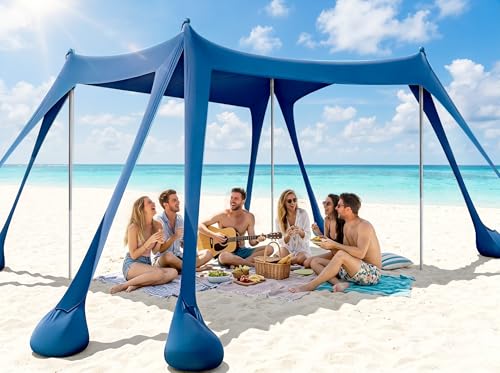
- 100 square feet of coverage for up to eight people
- Eight sandbags and four aluminum poles support stability
- UPF 50+ Lycra canopy with 8-pound portable design
Best For: Families and groups wanting extensive beach shade
Fastest Setup for Small Groups

- One-person setup in about one minute
- Two stabilizing bars and four sandbags help resist wind
- Folding, waterproof shelter for three to four people
Best For: Small groups prioritizing quick setup and portability
Most Adjustable in Changing Winds

- Designed for winds from 3 to 30 MPH
- Rotates toward changing wind by moving sandbags
- Includes tie-downs for low- or no-wind anchoring
Best For: Small groups facing shifting beach winds
Best with Extra Features
8×8 Wind-Resistant Beach Canopy

- 64 sq. ft. of family shade
- UPF 50+ waterproof fabric
- Sandbags, stakes, and vented roof
Best For: Families wanting generous, adjustable beach coverage
Best Wind-Responsive Shade

- Wind-lofted design captures breezes
- 100 sq. ft. of UPF 50+ shade
- 6.3-pound, three-minute setup
Best For: Groups seeking lightweight shade for breezy beaches
Best Family Cabana – CoolCabana Medium
The CoolCabana Medium is a practical choice for shoppers seeking wind resistant beach tents with generous shade and simple setup. Its four sand pockets provide up to 35 pounds of ballast when filled, while the aluminum frame and UPF 50+ fabric create a comfortable family shelter.
Best For: Families and groups wanting spacious, portable shade with straightforward one-person setup.
Pros:
- Four corner sand pockets help stabilize the cabana in windy conditions.
- Provides 43 square feet of shade with UPF 50+ protection.
- Folds to about 3 feet 2 inches for easier transport and storage.
- Water-resistant fabric and an aluminum frame support outdoor use.
Cons:
- The medium model offers less coverage than the large version.
- It does not include the enclosed privacy features of a traditional tent.
Choose this model if your priority is open, roomy shade rather than full enclosure. The corner sand pockets make it a strong fit for breezy beach days, provided they are filled securely.
Best Pop-Up Shelter – OutdoorMaster Beach Tent
The OutdoorMaster is a useful option among wind resistant beach tents when you want quick setup and more enclosed coverage. Its five built-in sandbags work with stakes and wind ropes to anchor the shelter, while mesh windows improve airflow for up to four occupants.
Best For: Families seeking an instant-setup shelter with privacy, ventilation, and multiple anchoring points.
Pros:
- One-person pop-up setup takes only seconds.
- Five sandbags, stakes, wind ropes, and fiberglass poles support wind resistance.
- UPF 50+ fabric, water resistance, and three mesh windows provide versatile protection.
- Zippered door and interior storage pockets add convenience.
Cons:
- At 6.6 pounds, it is heavier than some open canopy designs.
- The enclosed dimensions may feel less spacious for four adults.
This shelter balances fast assembly with practical anchoring and privacy features. It is particularly appealing when changing space and ventilation matter as much as sun protection.
Best Adjustable Cabana – 6.5-Foot Adjustable Beach Cabana
This adjustable beach cabana is designed for shoppers comparing wind resistant beach tents with flexible family coverage. Metal poles, spiral sand anchors, four corner sandbags, additional bottom sandbags, and stakes create layered support, while the height adjusts from 6.5 to 7.5 feet.
Best For: Groups of four to six who want adjustable headroom, removable side protection, and a stable canopy.
Pros:
- Multiple sandbags, spiral anchors, metal poles, and stakes help defend against wind.
- Fits four to six people within a 6.5-by-6.5-foot footprint.
- Adjustable height accommodates sitting, lounging, or standing.
- Removable side curtain, top vent, pockets, and hooks improve usability.
Cons:
- The 120-inch-by-120-inch footprint may require more beach space than compact shelters.
- Its multi-part anchoring setup may take more effort than a simple pop-up design.
Consider this cabana if you value configurable shade and a more structured setup. The removable curtain lets you adjust privacy and airflow, while the layered anchoring system suits breezier conditions.
Best Wind-Powered Shade – Shibumi Shade Mini
The Shibumi Shade Mini takes a different approach to wind resistant beach tents by using the breeze to support its canopy. Designed to sail with wind as light as 3 mph, it provides 75 square feet of UPF 50+ shade and sets up in about two minutes.
Best For: Lightweight beachgoers who prefer an open canopy that works with the wind instead of resisting it.
Pros:
- Wind-powered design is intended to stay functional in breezy conditions.
- Provides 75 square feet of shade for up to four people.
- Sets up in about two minutes with one set of hands.
- Lightweight, compact, and made with 40% ocean-bound recycled plastic.
Cons:
- It relies on suitable wind direction and speed for its wind-powered design.
- The open canopy does not provide a zippered door or enclosed privacy area.
This is a strong match for shoppers who want minimal carrying weight and broad open shade. Its wind-assist system distinguishes it from conventional anchored shelters, though it is best suited to beaches with a usable breeze.
Most Spacious Wind-Ready Shade – 10 x 10 ft Beach Canopy
For shoppers comparing wind resistant beach tents, this 10 x 10-foot canopy stands out for its generous coverage and reinforced setup. Eight extra-large sandbags and four thicker aluminum poles are designed to improve stability in breezy conditions, while the UPF 50+ Lycra canopy provides broad sun protection.
Best For: Families and groups needing up to 100 square feet of shaded space for beach trips, picnics, or camping.
Pros:
- Spacious 10 x 10-foot coverage for up to eight people
- Eight large sandbags and four aluminum poles support wind resistance
- UPF 50+ Lycra fabric blocks over 96% of harmful UV rays
- Weighs 8 pounds and is designed for one-person setup in under five minutes
Cons:
- Its large footprint may be more shade than smaller groups need
- The canopy requires filling and positioning eight sandbags
This is a strong choice when stability and maximum shade matter most. Its aluminum frame, water-resistant fabric, and included carry bag make it practical for recurring outdoor use, though the full-size design may be less convenient than compact shelters.
Fastest Setup for Small Groups – UPF50+ Pop-Up Beach Shelter
Among wind resistant beach tents, this pop-up shelter focuses on quick deployment and straightforward anchoring. Two reinforced stabilizing bars and four anti-wind sandbags create a dual fixation system, while the folding design makes it easy to transport to the beach, park, lake, or campsite.
Best For: Three to four people who want a compact, fast-setting shade shelter for travel and outdoor gatherings.
Pros:
- One person can unfold and secure it in about one minute
- Two stabilizing bars and four sandbags improve wind resistance
- UPF50+ protection and waterproof construction
- Lightweight folding design fits in a trunk or luggage compartment
Cons:
- Its listed capacity is limited to approximately three or four people
- The 78.7-by-63-inch footprint provides less coverage than larger canopies
This shelter is best when setup speed and portability take priority over maximum room. Its compact dimensions suit smaller groups, and the reinforced bars and sandbags offer a practical anchoring system for beach and camping use.
Most Adjustable in Changing Winds – Shark Fin Beach Shade
This Shark Fin shelter is designed for shoppers seeking wind resistant beach tents with adjustable anchoring. Its pole-and-sandbag setup supports winds from 3 to 30 MPH according to the supplied product notes, and the shade can be rotated toward shifting wind. Included tie-downs also provide a no-wind anchoring option.
Best For: Beachgoers who want adjustable wind positioning for one to four people.
Pros:
- Designed to work in wind conditions from 3 to 30 MPH
- Shade can be rotated by repositioning the front sandbags
- Includes two sandbags and extra strings for no-wind anchoring
- Umbrella-style expansion requires no assembly and includes UPF 50+ protection
Cons:
- The smaller size is intended for one to four people
- Wind performance depends on properly anchoring and adjusting the sandbags
The Shark Fin Shade is a specialized option for beaches with changing or unpredictable breezes. Its rotating design and included tie-downs provide more adjustment than a basic fixed canopy, while the 90-square-foot large model offers useful coverage for smaller groups.
Best with Extra Features – 8×8 Wind-Resistant Beach Canopy
For shoppers comparing wind resistant beach tents, the Zeraty Beach Cabana combines a spacious 8×8-foot footprint with a rigid aluminum frame, four sandbags, ground stakes, and a vented roof. Its UPF 50+ silver-coated fabric and detachable mesh side wall add useful sun protection for family beach days.
Best For: Families or groups needing a large, enclosed-feeling shade area with adjustable height and quick setup.
Pros:
- 64 square feet of shade accommodates multiple chairs or a children’s play area.
- Thickened aluminum poles, four sandbags, stakes, and a vented roof support stability in coastal conditions.
- UPF 50+ waterproof fabric and a detachable breathable mesh side wall provide flexible coverage.
- Single-person pop-up setup and an included carry bag make transport practical.
Cons:
- The 8×8 design is larger to carry and store than a compact personal shelter.
- The side wall is detachable, so full side coverage requires an extra setup step.
The Zeraty is a strong choice when family-sized coverage matters as much as wind resistance. Its combination of anchoring hardware, ventilation, and weather-protective fabric makes it more versatile than a basic beach umbrella.
Best Wind-Responsive Shade – 100-Sq.-Ft. Beach Canopy
The MoKo stands out among wind resistant beach tents with a wind-lofted design that uses airflow to create shade when a breeze reaches about 3 mph. Its open structure, reinforced guy ropes, four sandbags, and ground pegs help reduce wind pressure while providing 100 square feet of open shelter.
Best For: Groups of four to six who want lightweight, panoramic shade for breezy coastal trips.
Pros:
- About 100 square feet of shade can fit four beach chairs and four to six people.
- The wind-lofted design works with a breeze, while a support pole enables use in windless conditions.
- Open sides promote ventilation and help prevent wind pressure from building up.
- Tool-free setup takes about three minutes, and the packed shelter weighs 6.3 pounds.
Cons:
- The canopy is not water resistant, according to the supplied specifications.
- Its wind-responsive design depends on proper guy-rope, peg, and sandbag anchoring.
This MoKo canopy is a particularly portable option for sunny, breezy outings. Choose it for airflow and expansive open shade rather than rain protection or a fully enclosed tent experience.
Best Large Adjustable Shelter – 10×10 Family Beach Canopy
For a large, straightforward option among wind resistant beach tents, the UMARDOO uses four 0.75-inch aluminum poles and four large sandbags to form a stable support structure. Its 10×10-foot canopy provides 100 square feet of UPF 50+ shade and can be adjusted by moving the sandbags or changing pole positions.
Best For: Families and groups of four to eight who want adjustable shade for beaches, parks, fishing trips, or picnics.
Pros:
- 10×10-foot coverage comfortably accommodates four to eight people.
- Four aluminum poles and large sandbags create a stable, wind-resistant setup.
- UPF 50+ Lycra fabric is water resistant and elastic for adaptable positioning.
- At 6.8 pounds, it includes a 600D polyester carry bag for transport.
Cons:
- The large footprint and four-pole design require more setup space than a compact shelter.
- The supplied notes describe the fabric as water resistant, not fully waterproof.
- Adjusting the shade angle may require repositioning sandbags or poles.
The UMARDOO offers a useful balance of coverage, portability, and adjustability. It is a practical pick when you need broad group shade and prefer a traditional pole-and-sandbag system.
How We Picked the Best Wind Resistant Beach Tents
We focused on the features that matter most at the beach: resistance to shifting wind, reliable anchoring, useful shade coverage, UV protection, setup simplicity, and portability. The selection includes pop-up tents, cabanas, canopies, and wind-supported shade systems so you can match the shelter to your group size and preferred setup style.
We also considered practical details such as included sandbags or tie-downs, removable walls, carry bags, packed size, and whether the design is better suited to calm recreational beaches or breezier coastlines. Manufacturer wind claims should be treated as guidance rather than a guarantee; never leave a beach shelter unattended or use it in unsafe conditions.
Quick Comparison
| Best For | Look For | Typical Advantage |
|---|---|---|
| Couples or small families | Compact pop-up shelter | Fast setup and easier carrying |
| Families needing flexibility | Adjustable height or removable walls | Customizable shade and ventilation |
| Large groups | 8-by-8 or 10-by-10-foot canopy | More usable covered space |
| Windy beaches | Wind-supported design and secure tie-downs | Less reliance on rigid frames |
| Frequent beach travelers | Lightweight frame and carry bag | Easier transport and storage |
Key Buying Factors for Wind-Resistant Beach Tents
Anchoring and Wind Management
Prioritize shelters with sandbags, deep anchor points, guy lines, or tie-downs. A broad canopy can catch substantial wind, so proper anchoring is just as important as the frame design. Check the manufacturer’s instructions and fill every included sandbag before extending the shelter fully.
Coverage and Layout
Consider both the advertised footprint and the shade available throughout the day. Side walls can block low-angle sun and provide privacy, while open canopies offer better airflow. For four or more people, a larger shelter usually feels more comfortable, especially when storing coolers, chairs, and beach bags underneath.
UV Protection and Ventilation
UPF 50+ fabric is a useful baseline for reducing ultraviolet exposure, but it does not replace sunscreen, protective clothing, or avoiding peak sun. Open sides and vented panels help prevent heat buildup, while removable walls let you adapt to changing conditions.
Setup, Weight, and Packed Size
Pop-up systems are convenient, but some require more effort to anchor securely. Wind-powered canopies may be lighter and faster once positioned correctly. Before buying, check the packed dimensions, total weight, carry-bag quality, and whether setup can realistically be handled by one person.
Who Should Buy Which Wind Resistant Beach Tents?
Choose a compact pop-up beach tent if you value speed, portability, and shade for a small group. Families should look for adjustable-height cabanas or shelters with removable side walls, which provide more control over sun, wind, and privacy. Large groups will benefit from 8-by-8- or 10-by-10-foot canopies, provided they have enough anchors and space on the beach.
If you regularly visit windy shorelines, prioritize wind-supported designs, robust tie-downs, and complete anchoring systems over the largest possible footprint. For occasional beach trips, a lighter shelter with straightforward setup may be the better overall value. Whichever model you choose, follow the setup instructions, secure it carefully, and take it down when conditions become unsafe.