Reliable communication and weather information matter when a hike runs longer than planned or conditions change quickly. The best emergency radios for hiking combine NOAA alerts, dependable backup charging, useful lighting, and enough battery capacity for essential devices.
This roundup compares 10 models across those practical features, helping you choose a radio that fits day hikes, remote trekking, emergency kits, or extended backcountry use.
Best 10 Emergency Radios for Hiking Picks for 2026
Best All-Around Backup
FosPower A1 Emergency Weather Radio

- 2,000mAh phone-charging power bank
- Solar, hand-crank, USB-C, and AAA power
- NOAA reception plus two light sources
Best For: Hikers wanting versatile backup power and lighting
Best for Emergency Features

- NOAA weather scan and alert function
- Includes flashlight and ultrasonic dog whistle
- Six AA batteries included
Best For: Hikers focused on alerts and emergency signaling
Best Lightweight Pick
RunningSnail Compact Crank Radio

- Compact 7.84-ounce design
- NOAA, AM, and FM reception
- 2,000mAh battery with solar and crank charging
Best For: Lightweight hiking and day-trip emergency kits
Best High-Capacity Option
Roxicosly Rugged Weather Radio

- 12,000mAh battery and five charging methods
- IPX6 waterproof construction
- 5W flashlight and 12-LED reading lamp
Best For: Extended trips and wet-weather emergency preparedness
Best Compact Power Bank Radio
Leaton 10000mAh Emergency Radio

- 10,000mAh battery with USB phone charging
- NOAA, AM/FM, flashlight, lamp, and compass
- Compact IPX6 splash-resistant design
Best For: Hikers needing backup power and basic emergency lighting
Best High-Capacity Alert Radio
Mesqool 12000mAh Weather Radio

- 12,000mAh battery with solar, crank, and USB-C charging
- NOAA, AM/FM reception and long-range flashlight
- Large controls, reading lamp, and SOS alarm
Best For: Longer outings and off-grid emergency preparedness
Best Preparedness Bundle
37000mWh Radio with Survival Gear
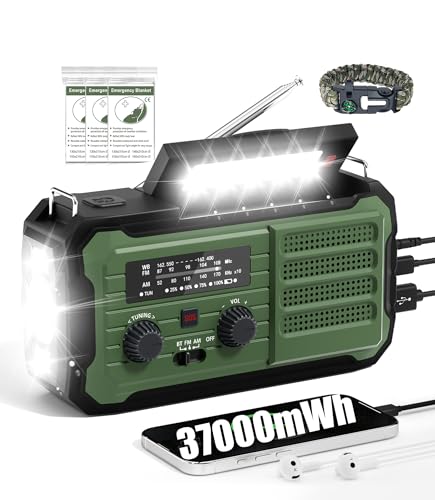
- 37,000mWh battery with solar and hand-crank charging
- Automatic scanning across seven weather channels
- Includes blanket, paracord bracelet, flashlight, and SOS alarm
Best For: Hikers wanting alerts plus bundled survival accessories
Versatile Trail Backup
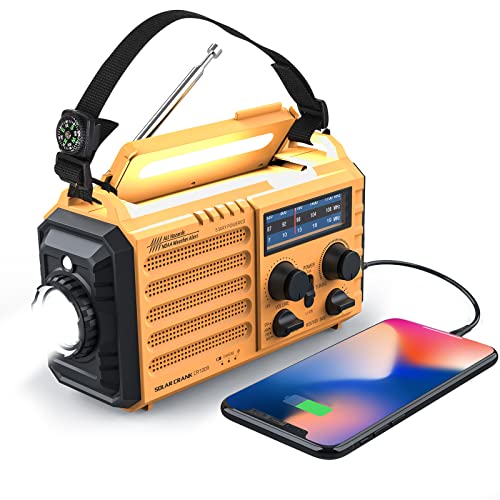
- Five power sources, including solar and hand crank
- NOAA, AM/FM/SW, flashlight, lamp, and SOS siren
- Compass, carabiner, USB charging, and headphone jack
Best For: Hikers seeking a flexible, multipurpose emergency radio
High-Capacity Trail Power

- 12000mAh battery with solar, crank, USB-C, and AAA backup
- NOAA, AM/FM reception with DSP tuning and extended antenna
- 5W flashlight, 120dB SOS alarm, and IPX6-rated construction
Best For: Outdoor users prioritizing long reserve power and rugged signaling
Lightweight Day-Hike Option
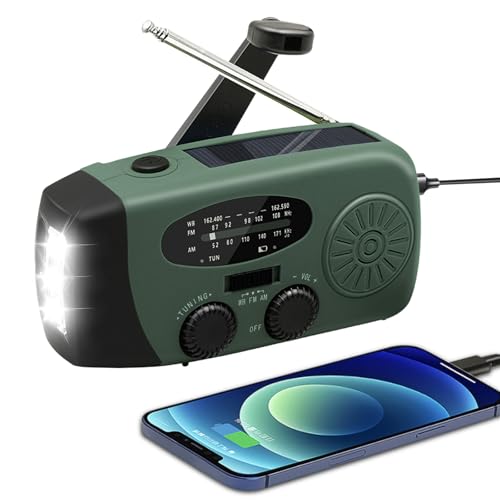
- Compact 231-gram design for lighter packs
- Solar, hand-crank, and rechargeable power options
- NOAA weather channels, lighting, SOS, and 2000mAh charger
Best For: Day hikers wanting essential features in a compact radio
Best All-Around Backup – FosPower A1 Emergency Weather Radio
For hikers who want a versatile option among emergency radios for hiking, the FosPower A1 combines NOAA, AM, and FM reception with several ways to maintain power. Its hand crank, solar panel, AAA battery support, and 2,000mAh power bank make it useful when charging access is limited.
Best For: Hikers who want phone-charging capability, weather broadcasts, and multiple backup power options in one compact radio.
Pros:
- 2,000mAh power bank can provide emergency power to a phone or small tablet.
- Uses solar, hand-crank, USB-C, and AAA battery power options.
- Includes NOAA weather access, a 1W flashlight, and a four-LED reading light.
Cons:
- Its 6.2-inch length and 310-gram weight may be more noticeable in a lightweight hiking kit.
- The power bank is intended for emergency charging rather than replacing a dedicated power bank.
The A1 is a practical choice when communication, lighting, and weather information matter as much as weight. Its limited lifetime warranty is an additional benefit for long-term emergency-kit use.
Best for Emergency Features – Midland ER310 Weather Radio
The Midland ER310 is a straightforward pick for hikers prioritizing emergency alerts and signaling features. It offers NOAA weather scan and alert capability, multiple power sources, a built-in flashlight, and an ultrasonic dog whistle in a portable red-and-black design.
Best For: Outdoor users who value weather alerts and dedicated emergency signaling features over maximum charging capacity.
Pros:
- NOAA weather scan and alert function helps deliver emergency information.
- Includes multiple power sources and six included AA batteries.
- Built-in flashlight and ultrasonic dog whistle add useful emergency functions.
Cons:
- It supports AM/FM rather than the broader AM/FM/weather-band specification listed for some alternatives.
- The radio is not water resistant, so it needs protection in wet conditions.
- The supplied details do not specify a battery capacity for phone charging.
The ER310 makes sense for hikers who want a dedicated preparedness tool with alerting and signaling functions. Pack it in a waterproof pouch because the listed enclosure is not water resistant.
Best Lightweight Pick – RunningSnail Compact Crank Radio
At 5 inches long and 7.84 ounces, the RunningSnail is a compact option for hikers comparing emergency radios for hiking. It combines NOAA, AM, and FM reception with a 2,000mAh rechargeable battery, hand-crank and solar charging, USB phone charging, and a bright 1W flashlight.
Best For: Day hikers and lightweight packers who want basic weather information, emergency charging, and illumination without much bulk.
Pros:
- Compact 5-by-1.8-by-2.4-inch design weighs only 0.5 pound.
- Provides NOAA, AM, and FM reception with a retractable antenna.
- Offers a 2,000mAh battery, hand-crank and solar power, and USB charging.
Cons:
- The listed battery capacity is smaller than the 12,000mAh capacity claimed by one larger alternative.
- It has a single 1W flashlight rather than a separate reading lamp.
- The one-year manufacturer warranty is shorter than the lifetime warranty listed for the FosPower model.
The RunningSnail stands out when pack space and weight are important. Its water-repellent construction adds some outdoor practicality, but it should still be protected from sustained heavy rain.
Best High-Capacity Option – Roxicosly Rugged Weather Radio
The Roxicosly CR1030 is designed for hikers who want substantial backup power and stronger weather protection. Its listed 12,000mAh battery, large solar panel, hand-crank generator, five charging methods, IPX6 waterproofing, and dual lights make it the most feature-heavy option in this group.
Best For: Extended outdoor trips and emergency kits where battery capacity, waterproofing, lighting, and phone charging are priorities.
Pros:
- 12,000mAh battery is designed to charge phones and power emergency lighting.
- IPX6 waterproofing suits wet outdoor conditions better than non-water-resistant models.
- Includes AM/FM and seven NOAA bands, a 5W adjustable flashlight, and a 12-LED reading lamp.
Cons:
- At 824 grams, it is substantially heavier than the compact RunningSnail.
- The 6.8-by-2.88-by-4.74-inch body takes more pack space.
- Its larger capacity and feature set may be unnecessary for short day hikes.
The CR1030 is compelling for demanding trips and wet-weather preparedness, especially when a larger battery and brighter lighting justify the added weight. It is less suitable for minimalist hikers counting every ounce.
Best Compact Power Bank Radio – Leaton 10000mAh Emergency Radio
For hikers who want emergency radios for hiking with useful backup power, the Leaton combines NOAA, AM/FM reception, a 10,000mAh internal battery, lighting, and three charging options in a compact package. Its IPX6 rating helps protect against water spray and splashes, though it is not designed for immersion or heavy rain.
Best For: Hikers and campers who prioritize phone backup charging, basic weather listening, and compact emergency lighting.
Pros:
- 10,000mAh battery can provide approximately 1–1.5 iPhone 14 charges, depending on conversion and device efficiency.
- Supports USB-C, solar, and hand-crank charging.
- Includes NOAA/AM/FM radio, compass, three-mode flashlight, and reading lamp.
- Compact design weighs about 1.1 pounds and fits readily in a backpack.
Cons:
- NOAA reception requires manual tuning and does not provide SAME or automatic alerts.
- IPX6 protection is for splashes and spray, not submersion or severe rainfall.
- Hand-crank runtime and phone charging vary with cranking speed and conversion losses.
The Leaton is a practical, feature-rich choice when charging capacity and portability matter more than automatic alerting. Keep its manual NOAA operation in mind when comparing it with radios that scan or alert automatically.
Best High-Capacity Alert Radio – Mesqool 12000mAh Weather Radio
The Mesqool is one of the more capable emergency radios for hiking if you want high battery capacity, multiple power sources, and easy-to-use controls. It combines NOAA, AM/FM reception with a 12,000mAh battery, a large solar panel, hand crank, USB-C input, lights, and an SOS alarm.
Best For: Longer trips, emergency kits, and users who want strong lighting and several ways to replenish power off-grid.
Pros:
- 12,000mAh lithium battery provides substantial reserve power for radio use and device charging.
- Large 8,500mm² monocrystalline solar panel is designed to capture more sunlight than smaller decorative panels.
- Features NOAA, FM, and AM reception, plus a flashlight rated for a beam up to 260 feet.
- Large tuning knob, clear labels, non-slip grip, reading lamp, and SOS alarm support straightforward operation.
Cons:
- At 6.8 x 2.9 x 4.7 inches, it is larger than some compact hiking radios.
- The supplied notes recommend fully charging the battery before first use.
- Solar and hand-crank charging performance depends on available sunlight and user effort.
The Mesqool stands out for hikers who prefer capacity and usability over the smallest possible pack size. Its large controls and multiple charging methods make it a flexible choice for both trail kits and household preparedness.
Best Preparedness Bundle – 37000mWh Radio with Survival Gear
This option pairs a high-capacity emergency radio with several trail-oriented extras, making it appealing for hikers building a broader safety kit. In addition to hand-crank, solar, and battery power, it includes automatic NOAA weather scanning, an SOS alarm, headphone jack, thermal blanket, and survival paracord bracelet.
Best For: Hikers who want one purchase to cover weather alerts, emergency lighting, signaling, warmth, and basic survival tasks.
Pros:
- 37,000mWh rechargeable battery offers extended stored energy for emergencies and outdoor use.
- Automatically scans seven weather-band channels and can provide alerts while in standby mode.
- Includes flashlight, USB port, headphone jack, and SOS alarm with flashing red light.
- Thermal blanket and paracord bracelet add shelter, signaling, navigation, and fire-starting tools.
Cons:
- The supplied details do not specify the radio’s dimensions or total weight.
- The thermal blanket and bracelet add versatility but may be unnecessary for hikers who already carry dedicated gear.
- Actual charging and runtime will depend on sunlight, hand-crank effort, and usage.
The main advantage here is breadth: it is more than a radio, with several emergency accessories bundled in. Choose it when automatic weather scanning and extra survival equipment are priorities, rather than when minimizing pack contents is the goal.
Versatile Trail Backup – Raynic Weather Radio
For hikers wanting emergency radios for hiking with several backup charging options, the Raynic combines AM/FM/SW and NOAA reception with lighting, phone charging, and a compass. Its compact design and included carabiner make it practical for emergency kits and outdoor travel.
Best For: Hikers who want a multipurpose radio with broad power options and basic navigation support.
Pros:
- Offers hand-crank, solar, corded-electric, rechargeable-battery, and AAA power options.
- Includes NOAA weather channels, AM/FM/SW tuning, a 3W flashlight, and a 2.5W reading lamp.
- Provides emergency phone or USB-device charging, an SOS siren, compass, carabiner, and headphone jack.
- Its water-resistant IPX3 construction and 1.2-pound weight suit outdoor use.
Cons:
- NOAA alerts require the radio to be powered on and manually tuned to a local station.
- IPX3 water resistance is more limited than the waterproof ratings offered by some rugged radios.
- The listed dimensions vary between the product notes and specifications, so pack fit should be checked carefully.
The Raynic is a well-rounded choice when flexibility matters more than minimum weight. Its combination of charging methods, lighting, compass, and weather reception gives hikers several useful backup tools in one unit.
High-Capacity Trail Power – OnLyee 12000mAh Radio
Among emergency radios for hiking, the OnLyee stands out for its large 12000mAh battery, bright lighting, and rugged construction. NOAA, AM, and FM reception plus solar, hand-crank, USB-C, and AAA backup options make it suited to longer trips and uncertain conditions.
Best For: Campers, hikers, and emergency planners who prioritize battery capacity, durability, and brighter signaling features.
Pros:
- Large 12000mAh rechargeable battery supports the radio, lights, and emergency phone charging.
- Uses an oversized 8500mm² solar panel, high-torque hand crank, USB-C input, and three AAA batteries.
- Features NOAA, AM, and FM reception, DSP tuning, an extended antenna, and a 57mm speaker.
- Includes a 5W flashlight, foldable reading lamp, 120dB SOS alarm, and flashing beacon.
Cons:
- At 1.6 pounds, it is heavier than the smaller WVL option in this roundup.
- The larger battery and rugged housing may take more pack space than a minimalist hiker wants.
- Phone charging remains an emergency-power feature rather than a replacement for a dedicated power bank.
The OnLyee is the strongest fit for hikers who want substantial reserve power and a loud, visible distress signal. Its 1.6-pound weight is a tradeoff for the bigger battery, 5W light, and IPX6-rated, dustproof, shock-resistant design.
Lightweight Day-Hike Option – WVL Emergency Radio
For hikers comparing compact emergency radios for hiking, the WVL keeps the essentials in a small 231-gram package. It combines AM/FM/WB weather reception with a hand crank, solar charging, built-in battery, flashlight, reading lamp, phone charger, and SOS alarm.
Best For: Day hikers and lightweight packers who want basic weather information, lighting, and emergency charging without a bulky radio.
Pros:
- Compact 5.9-by-3.07-by-2.4-inch design weighs about 231 grams.
- Provides three power sources: hand crank, solar panel, and built-in Li-ion rechargeable battery.
- Includes AM/FM/WB preset NOAA channels, a 1.5W flashlight, and motion-sensor reading lamp.
- Offers a 2000mAh emergency phone or small-tablet charger and SOS alarm.
Cons:
- The 2000mAh phone charger is smaller than the 12000mAh battery in the OnLyee radio.
- The supplied specifications identify the tuner as AM and list three radio bands, so reception details are less extensive than the title suggests.
- The notes do not specify a water-resistance rating.
The WVL is the easiest of these radios to justify for a lightweight day pack. It gives up battery capacity and documented weather protection, but its small footprint and low weight make it convenient for carrying essential backup functions.
How We Picked These Emergency Radios for Hiking
We focused on features that can make a meaningful difference outdoors: NOAA weather reception and alerts, AM/FM access, battery capacity, solar and hand-crank charging, flashlight functionality, portability, and phone-charging support. A radio should be simple to operate under stress, provide useful information when cellular service is unavailable, and offer more than one way to stay powered.
Battery ratings are useful for comparing models, but real-world runtime varies with signal strength, volume, flashlight use, temperature, and charging conditions. Solar panels and hand cranks are best treated as backup charging methods rather than instant replacements for a full battery.
Quick Comparison
| Feature | What to look for | Why it matters |
|---|---|---|
| Weather information | NOAA reception and weather alerts | Helps you monitor changing conditions without phone service |
| Power options | Rechargeable battery, solar panel, hand crank, and USB input | Provides flexibility when outlets are unavailable |
| Battery capacity | About 5,000mAh to 12,000mAh in this group | Supports longer radio use and limited device charging |
| Lighting | Directional flashlight or lantern-style reading lamp | Improves visibility around camp or during an emergency |
| Portability | Compact body, carry handle, and manageable weight | Makes the radio more practical in a hiking pack |
Key Buying Factors for Emergency Radios for Hiking
NOAA Alerts and Reception
Choose a model with NOAA weather-band reception and an alert function if early warnings are important to you. Check that controls are easy to identify and that the speaker is loud enough for outdoor use. Reception can vary by terrain, so no radio should replace checking the forecast before leaving.
Charging and Battery Capacity
Higher-capacity models can run longer and may provide more phone-charging capability, but they are often larger and heavier. For short hikes, a compact radio with a moderate battery may be sufficient. For remote trips or emergency preparedness, prioritize multiple charging options and a larger battery.
Size, Durability, and Lighting
Look for a body that fits securely in your pack and controls that remain usable with cold or wet hands. A built-in flashlight is convenient, while a reading lamp can be helpful inside a tent or shelter. Confirm any water-resistance claims before relying on a radio in severe weather.
Who Should Buy Which Emergency Radios for Hiking?
For Day Hikers and Lightweight Kits
Choose a compact, lower-capacity model with NOAA alerts, a flashlight, and hand-crank charging. It should add emergency capability without taking up much pack space.
For Remote or Multi-Day Hikers
Prioritize a larger battery, dependable weather alerts, multiple charging methods, and a sturdy carry design. A model with phone charging can provide useful backup power, though it should not be your only power source.
For Home-And-Trail Emergency Use
A higher-capacity radio with a bright flashlight, reading lamp, solar panel, and broad radio-band support offers greater versatility. These models may be bulkier, but they can serve both hiking kits and household emergency supplies.
Whichever model you choose, charge it before each trip, test the radio and alert settings, pack a charging cable, and keep it accessible rather than buried beneath heavy gear.