A dependable compass can help you stay oriented when trails are poorly marked, visibility drops, or electronic devices run out of power. The right model should be easy to read, durable enough for outdoor use, and matched to your navigation experience.
We’ve selected 10 compasses for hiking that cover everyday recreation, map-and-compass practice, backpacking, and more demanding navigation tasks. Use the guide below to compare features and choose the best fit for your trips.
Best 10 Compasses for Hiking Picks for 2026
Rugged Glow Navigator

- Metal body is waterproof and shock-resistant
- Rear sight lens supports precise readings
- Glow-in-the-dark dial and included pouch
Best For: Hikers wanting a durable, low-light-ready compass
Lightweight Trail Specialist

- Weighs just 1.6 ounces
- Transparent baseplate and magnifying lens
- Luminous markings and battery-free operation
Best For: Lightweight map navigation and orienteering
Professional Sighting Tool

- Lensatic sighting design with adjustable prism
- Built-in clinometer measures slopes and height
- Metal, waterproof, shockproof construction
Best For: Terrain navigation and survival-oriented hiking
Beginner Map Navigator
TurnOnSport Orienteering Compass
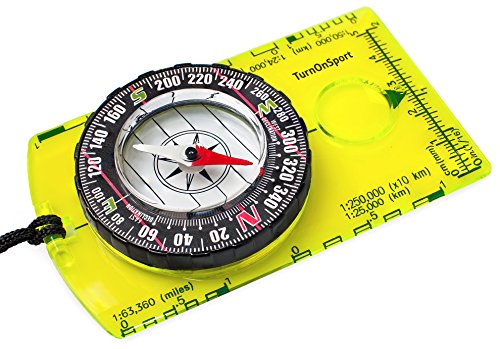
- Lightweight acrylic baseplate design
- Rotating bezel and magnetic needle
- Includes magnifier, 1:24,000 scale, and lanyard
Best For: Beginners, scouts, and basic map navigation
Simple Trail Companion

- Compact baseplate with inch/cm scales
- Liquid-filled capsule and steel needle
- Fixed declination for northern hemisphere use
Best For: Recreational hiking and map navigation
Night-Ready Navigation
Pocket Lensatic Survival Compass

- Lensatic design with prism lens and bubble level
- Glow-in-the-dark interface for low light
- Water-resistant aluminum construction
Best For: Camping and low-light outdoor navigation
Group Navigation Value
Four-Pack Orienteering Compasses

- Four compasses for groups or spares
- Adjustable declination and rotating bezel
- Magnifier, ruler, and distance scale included
Best For: Group hikes and introductory orienteering
Clip-On Trail Companion

- Liquid-filled compass with luminous directional markers
- Built-in carabiner for quick gear attachment
- Compact aluminum body weighs just 0.6 ounces
Best For: Portable, quick-access navigation on hikes and camping trips
Ultra-Compact Specialist

- Five-gram clip-mount design for hands-free carrying
- Waterproof, liquid-filled, and battery-free
- Luminescent markings and 10-degree rotating bezel
Best For: Northern Hemisphere hikers wanting an ultralight strap- or pack-mounted compass
Rugged Navigation Tool

- Liquid-filled, luminous dial with adjustable marching line
- Includes sighting line, inclinometer, and rotating bezel
- Waterproof aluminum-alloy body with pouch and lanyard
Best For: Backcountry users needing durable construction and advanced sighting features
Rugged Glow Navigator – Sportneer Metal Compass
For hikers who want a durable, traditional instrument, this Sportneer model is one of the more rugged compasses for hiking. Its metal construction, rear sight lens, luminous markings, and included pouch make it suited to general outdoor navigation.
Best For: Camping, hiking, scouting, and low-light navigation when a sturdy metal compass is preferred.
Pros:
- Rear sight lens magnifies the dial for more precise readings.
- Waterproof and shock-resistant metal construction.
- Dial markings and the north indicator glow after exposure to light.
- Includes a strap and carrying pouch.
Cons:
- At 7.2 ounces, it is heavier than lightweight plastic compasses.
- Must be kept level for the magnetic needle to rotate and point accurately.
- The company notes the strap may feel slightly heavy for children.
The Sportneer is a practical choice when durability and nighttime visibility matter more than minimizing pack weight. Its sighting design adds useful precision, while the pouch and strap support convenient carrying.
Lightweight Trail Specialist – SUUNTO A-30 Compass
The SUUNTO A-30 is a compact option among compasses for hiking, with a transparent baseplate, magnifying lens, metric scales, and luminous markings. Its 1.6-ounce weight makes it especially attractive for hikers who want map-navigation features without adding much bulk.
Best For: Hiking, trekking, orienteering, and map work where low weight and low-light markings are priorities.
Pros:
- Very lightweight at 1.6 ounces.
- Transparent baseplate and magnifying lens help with map use.
- Luminescent markings support reading in low-light conditions.
- Requires no batteries.
Cons:
- Balanced for Northern Hemisphere use.
- Uses a fixed declination rather than an adjustable declination setting.
- Its plastic material may be less suited to heavy impacts than a metal compass.
With its compact format and map-friendly design, the A-30 is a sensible everyday hiking compass for users who value portability. Check the fixed-declination setup and regional balancing before relying on it for a particular route.
Professional Sighting Tool – Proster Lensatic Compass
This Proster lensatic compass is built for hikers who want sighting capability and terrain-measuring features. Its metal body, adjustable prism lens, clinometer, luminous dial, and IP65 waterproof design make it a feature-rich choice among compasses for hiking.
Best For: Survival navigation, hiking in challenging terrain, and users who need to estimate slopes or heights.
Pros:
- Vertical lubber line and sighting optic support direct, accurate readings.
- Built-in clinometer measures slopes and height.
- Foldable metal lid and shakeproof construction add protection.
- Luminous arrow and compass card support dark-environment readings after light exposure.
Cons:
- At 330 grams, it is considerably heavier than basic hiking compasses.
- The more involved lensatic design may take practice to use effectively.
- Luminous components need sufficient sunlight exposure first.
The Proster is best viewed as a rugged navigation instrument rather than a minimalist trail accessory. Choose it when sighting accuracy, a clinometer, and protective metal construction justify the added weight.
Beginner Map Navigator – TurnOnSport Orienteering Compass
The TurnOnSport Orienteering Compass is a straightforward, lightweight option for hikers, scouts, and beginners learning map navigation. Its acrylic baseplate, rotating bezel, magnifying glass, 1:24,000 scale, and lanyard cover the core features many people look for in compasses for hiking.
Best For: Beginner hikers, scouts, field trips, and lightweight map-reading practice.
Pros:
- Lightweight 0.04-kilogram plastic design.
- Rotating bezel and magnetic needle support basic orienteering.
- Magnifying glass helps with geological map reading.
- Includes a 1:24,000 ruler scale and lanyard.
Cons:
- Plastic construction may not offer the same ruggedness as metal models.
- The listed warranty is limited to 30 days.
- It is a manual compass without the additional sighting or clinometer features of more advanced models.
TurnOnSport offers a useful entry point for learning bearings and topographic-map basics without much pack weight. It is a good fit for casual outdoor use and scouting, while demanding expeditions may call for a more specialized instrument.
Simple Trail Companion – Compact A-10 Hiking Compass
The SUUNTO A-10 is a practical choice for hikers who want a compact, straightforward compass for map reading and basic outdoor navigation. Its liquid-filled capsule, high-grade steel needle, and fixed declination support stable, simple operation without batteries.
Best For: Recreational hiking, trekking, orienteering, and map-and-compass navigation.
Pros:
- Compact baseplate design with inch and centimeter scales.
- Liquid-filled capsule and jewel-bearing steel needle support stable readings.
- Designed for northern hemisphere use with fixed declination.
- Lightweight 0.03 kg construction with lanyard mounting.
Cons:
- Fixed declination is less flexible than adjustable-declination designs.
- Its recreational focus may not suit users seeking advanced navigation features.
The A-10 keeps things uncomplicated, making it a strong fit for hikers who value portability and quick, dependable direction checks over extra features.
Night-Ready Navigation – Pocket Lensatic Survival Compass
Compass, Hiking Compass for Survival with Lensatic – Water-Resistant Durable and Pocket-Sized
Check Price On AmazonThis pocket-sized lensatic compass is built for hikers who want added visibility and rugged features in a compact navigation tool. It combines a prism lens, bubble level, clear scales, water-resistant construction, and a fluorescent interface for low-light use.
Best For: Camping, hiking, mountaineering, and nighttime or low-light navigation.
Pros:
- Lensatic function, prism lens, and bubble level are designed to improve reading accuracy.
- Fluorescent markings and a glow-in-the-dark interface support low-light readings.
- Rugged aluminum construction is described as durable and water-resistant.
- Includes a carrying case, lanyard, or pouch for portability.
Cons:
- At 0.22 kg, it is heavier than a minimal recreational baseplate compass.
- The 91-day warranty is relatively short.
With its lensatic layout and nighttime visibility features, this compass suits hikers who prioritize added reading aids and durable pocket carry over ultralight weight.
Group Navigation Value – Four-Pack Orienteering Compasses
This four-pack offers a practical way to equip a hiking group, classroom, or backup kit with basic map-reading compasses. Each lightweight compass includes a rotating bezel, adjustable declination, magnifier, metric ruler, distance scale, and lanyard.
Best For: Group hikes, introductory orienteering, map-reading practice, and keeping spare compasses available.
Pros:
- Four compasses provide convenient group or backup coverage.
- Adjustable declination supports more flexible navigation.
- Built-in magnifier, metric ruler, and distance scale aid map reading.
- Lightweight plastic design includes lanyards for secure carrying.
Cons:
- Plastic construction may be less rugged than metal-bodied alternatives.
- The pack size may be unnecessary for solo hikers.
This set is especially useful when several people need their own compass or when you want affordable spares, while its integrated map tools add convenience on the trail.
Clip-On Trail Companion – Lightweight Carabiner Compass
For hikers who want a simple backup direction tool close at hand, Coghlan’s carabiner compass is a practical option. Its liquid-filled design, luminous markings, and compact aluminum body suit day hikes, camping trips, and low-light navigation.
Best For: Hikers who prioritize portability, quick access, and a built-in clip for attaching gear.
Pros:
- Liquid-filled design supports smooth directional readings.
- Built-in carabiner clips to a backpack, belt, or other gear.
- Luminous markers improve visibility in low-light conditions.
- Compact 0.6-ounce aluminum construction is easy to carry.
Cons:
- Its small clip-on format may be less suitable for detailed map work.
- The notes do not mention a sighting system or inclinometer.
This is a convenient, lightweight choice for keeping a compass accessible during everyday hikes. Choose it when minimal bulk and easy attachment matter more than advanced navigation features.
Ultra-Compact Specialist – Suunto Micro Compass
The Suunto Micro Compass is designed for hikers who want an exceptionally small navigation aid that stays attached to a strap, sleeve, backpack, or map edge. It is liquid-filled, waterproof, battery-free, and balanced for the Northern Hemisphere.
Best For: Northern Hemisphere hikers, trail runners, cyclists, and adventurers seeking an unobtrusive compass for hands-free use.
Pros:
- Extremely compact and lightweight at 5 grams.
- Clip-mount design attaches to straps, sleeves, backpacks, or map edges.
- Luminescent markings support use in low light.
- Waterproof, liquid-filled construction requires no batteries.
Cons:
- It is balanced for the Northern Hemisphere, limiting regional versatility.
- The very small format may be less convenient for users who prefer a larger dial.
Suunto’s micro compass is a strong fit when weight and attachment flexibility are top priorities. Its compact design is especially useful as an always-carried backup or for activities where a larger compass would get in the way.
Rugged Navigation Tool – Eyeskey Sighting Compass
For hikers who want more than basic direction finding, the Eyeskey multifunctional compass combines a liquid-filled dial with a sighting line, inclinometer, rotating bezel, and measurement conversion chart. Its rugged aluminum-alloy body is designed for demanding outdoor use.
Best For: Hikers, scouts, hunters, and campers who need sighting and orientation features in a durable, waterproof package.
Pros:
- Liquid-filled dial, luminous markings, and adjustable luminous marching line aid reading.
- Sighting line, thumb hold, and magnifying viewer support more precise orientation.
- Waterproof aluminum-alloy construction is built for rugged conditions.
- Includes a canvas pouch, lanyard, carrying box, and user manual.
Cons:
- Its multifunctional metal design is likely less compact than a basic clip-on compass.
- Additional features may be more than casual hikers need.
The Eyeskey is the most feature-rich option in this group for users who value sighting capability and a sturdy build. It makes sense for backcountry navigation and outdoor activities where a simple pocket compass may not provide enough control.
How We Picked These Compasses for Hiking
We focused on practical navigation features rather than appearance alone. Our selection considers directional accuracy, readability, construction, portability, water resistance, and how easily each compass can be used with a map. We also included a range of designs, from compact baseplate compasses and simple recreational models to lensatic sighting compasses with added tools.
Because intended use varies, the list includes options for beginners, casual hikers, scouts, backpackers, and users who want more advanced navigation capability. A compass is only as useful as the person using it, so ease of operation and the learning curve were also important considerations.
Quick Comparison
| Best For | Compass Type | Features to Look For |
|---|---|---|
| Beginners and casual hikes | Basic baseplate compass | Clear markings, simple orientation, compact size |
| Map reading and route planning | Orienteering compass | Transparent base, ruler, rotating bezel, declination adjustment |
| Advanced navigation | Lensatic or sighting compass | Sighting system, clinometer, durable housing |
| Emergency and backup use | Compact or multifunctional compass | Portability, water resistance, readable markings |
Key Buying Factors for Compasses for Hiking
Compass Style
Baseplate and orienteering compasses are generally the easiest choices for hiking with a map. Lensatic models can provide more precise bearings when sighting distant landmarks, but they usually take more practice to use correctly.
Readability and Low-Light Use
Look for bold degree markings, a clearly visible direction-of-travel arrow, and a bezel that turns smoothly without feeling loose. Luminous markings are useful around dawn, dusk, or inside a tent, but they may need exposure to light before they glow.
Declination Adjustment
Magnetic declination differs by location and can affect navigation over distance. If you regularly travel in different regions or use topographic maps, an adjustable declination feature can make bearing corrections faster and reduce mistakes.
Durability and Water Resistance
Outdoor compasses should tolerate rain, drops, and repeated handling. Water-resistant or waterproof construction is helpful, but it does not replace careful storage or protection from extreme heat, impact, and magnetic interference.
Size and Extra Features
A small compass is convenient for day hikes and emergency kits, while a larger baseplate may be easier to read and use with maps. Rulers, magnifiers, clinometers, lanyards, cases, and carabiners can be useful, but they should not outweigh basic accuracy and legibility.
Who Should Buy Which Compasses for Hiking?
Choose a simple baseplate compass if you are new to navigation or mainly hike established trails. It keeps the controls straightforward and works well for learning map orientation.
Choose an orienteering compass if you plan routes with topographic maps, practice navigation, or backpack away from marked trails. Declination adjustment, a clear base, and map scales are especially valuable.
Choose a lensatic or sighting compass if you need to take bearings on distant landmarks or want a more rugged emergency-navigation tool. Be prepared to practice, since these models require more precise handling.
Choose a compact multifunctional compass for a backup kit, vehicle, camping box, or occasional outdoor use. Before relying on it in remote terrain, test it against a known direction and practice taking a bearing with a map.