The best emergency radios with crank help you stay informed and powered up when severe weather or an outage disrupts normal services. Solar charging, NOAA alerts, built-in lights, and phone-charging features can make one a practical addition to any emergency kit.
We compared 10 popular models across battery capacity, charging options, alert coverage, lighting, portability, and everyday usability to help you choose the right backup radio for your home, vehicle, or go-bag.
Best 10 Emergency Radios with Crank Picks for 2026
Best All-Around Value
FosPower A1 Emergency Weather Radio

- 2,000mAh phone-charging power bank
- Solar, hand-crank, and AAA battery options
- NOAA access plus flashlight and reading light
Best For: Home emergency kits and versatile outdoor backup use
Best for Alert Features

- NOAA weather scan and alert
- Multiple power sources with six AA batteries included
- Flashlight and ultrasonic dog whistle
Best For: Preparedness kits focused on alerts and signaling
Best Compact Pick

- Lightweight 7.84-ounce design
- 2,000mAh battery with USB device charging
- NOAA/AM/FM, solar, crank, and LED flashlight
Best For: Go-bags, camping, and lightweight emergency carry
Best High-Capacity Option
Roxicosly CR1030 Weather Radio

- Stated 12,000mAh emergency battery
- Five charging methods and large solar panel
- IPX6 waterproofing with NOAA alerts and dual lights
Best For: Extended outages, severe weather, and rugged outdoor use
Best Overall
Raynic 5000mAh Emergency Weather Radio

- Automatic NOAA alert scanning
- Six charging methods, including crank and solar
- LCD, lights, SOS, and phone charging
Best For: Versatile home and camping preparedness
Best Survival Bundle
10000mAh Emergency Radio with Survival Accessories
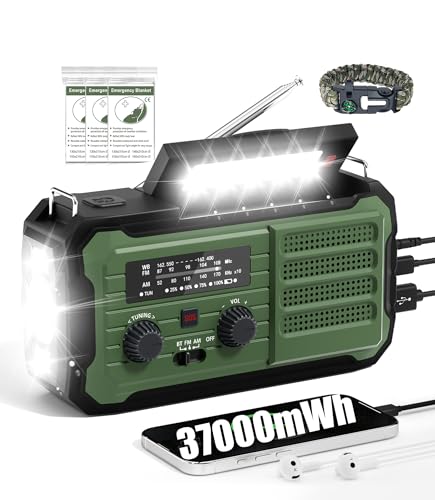
- 37,000mWh rechargeable battery
- Automatic seven-channel weather scanning
- Includes thermal blanket and paracord bracelet
Best For: Family emergency kits and outdoor survival gear
Best Weatherproof Option
OnLyee 12000mAh Solar Crank Radio

- 12,000mAh battery with solar, crank, and Type-C charging
- IPX6 water-resistant design
- 5W flashlight, reading lamp, and 120dB SOS alarm
Best For: Storm prep, camping, RVs, and wet conditions
Best All-Around Pick

- USB, solar, and hand-crank charging
- 2000mAh battery with long flashlight runtime
- AM/FM/NOAA radio, flashlight, and SOS alarm
Best For: Portable home, car, and camping preparedness
Best for Power Monitoring
iRonsnow 2000mAh Weather Radio
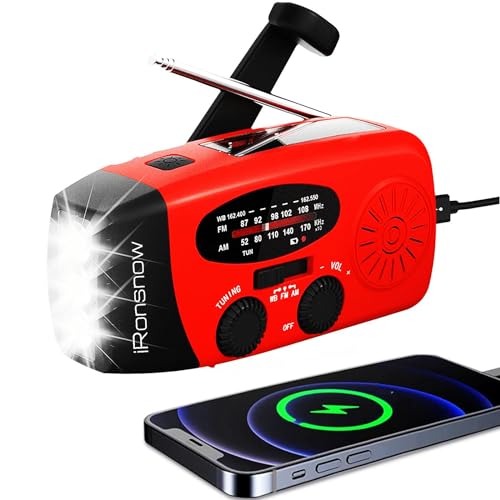
- Battery indicator shows four approximate charge levels
- USB-C, solar, and hand-crank charging
- Flashlight, SOS mode, weather band, and phone charging
Best For: Users who want visible battery status in a compact radio
Best for Lighting Versatility
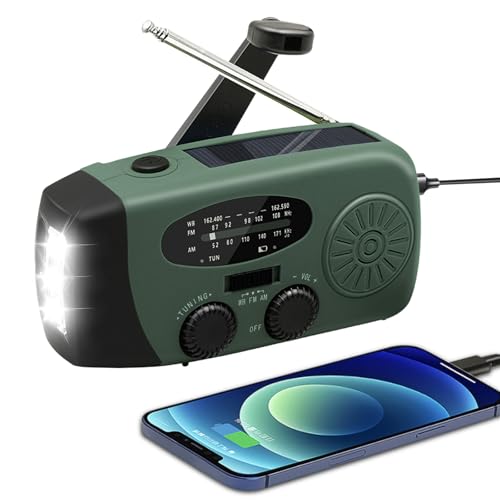
- Flashlight plus motion-sensor reading lamp
- Hand-crank, solar, and rechargeable power
- 2000mAh phone charger with AM/FM/WB reception
Best For: Outages, camping, and emergency kits needing flexible lighting
Best All-Around Value – FosPower A1 Emergency Weather Radio
For shoppers comparing emergency radios with crank, the FosPower A1 combines NOAA, AM, and FM reception with a 7,400mWh (2,000mAh) power bank. Its hand crank, solar panel, and AAA battery support provide flexible backup power for outages and outdoor use.
Best For: Home emergency kits and shoppers who want phone charging, weather broadcasts, and multiple lighting options in one compact radio.
Pros:
- 2,000mAh power bank can provide emergency power to a phone or small tablet.
- Supports solar, hand-crank, and four AAA battery power sources.
- Includes NOAA weather access, an SOS alarm, a 1W flashlight, and a four-LED reading light.
- Water-resistant design and limited lifetime warranty add practical preparedness value.
Cons:
- The included AAA batteries are disposable rather than rechargeable.
- The power bank is intended for small devices and emergency charging rather than heavy daily use.
This is a well-rounded pick when versatility matters more than maximum battery capacity. It covers communication, lighting, and backup charging without making the radio overly large.
Best for Alert Features – Midland ER310 Emergency Radio
The Midland ER310 is a practical choice among emergency radios with crank, especially for users who prioritize weather scanning and alert functions. It offers multiple power sources, an emergency flashlight, and a built-in ultrasonic dog whistle in a recognizable preparedness-focused design.
Best For: Emergency kits and outdoor users who want NOAA weather scan and alert capability alongside basic radio and lighting functions.
Pros:
- NOAA weather scan and alert feature helps monitor changing conditions.
- Multiple power sources support use during outages and outdoor emergencies.
- Built-in flashlight and ultrasonic dog whistle add useful signaling functions.
- Six AA batteries are included.
Cons:
- It is not water resistant according to the supplied specifications.
- The listing identifies AM/FM tuning and does not specify a built-in power-bank capacity.
- Its one-year limited warranty is shorter than some competing options.
The ER310 makes the most sense for buyers who value alert scanning and emergency signaling over a large rechargeable battery. Its feature set is focused on preparedness rather than maximum charging capacity.
Best Compact Pick – RunningSnail Hand Crank Radio
If portability is a priority, the RunningSnail is one of the more compact emergency radios with crank. Its 2,000mAh rechargeable battery, solar and hand-crank charging, NOAA/AM/FM reception, and bright LED flashlight cover the essentials for outages, camping, and evacuation bags.
Best For: Lightweight go-bags, camping, and users who want emergency phone charging in a small, water-repellent radio.
Pros:
- Compact 5-by-1.8-by-2.4-inch design weighs 7.84 ounces.
- Three power modes include hand crank, solar panel, and built-in rechargeable battery.
- 2,000mAh battery supports emergency charging for compatible USB devices.
- Retractable antenna, NOAA reception, and 1W flashlight support emergency use.
Cons:
- Its 2,000mAh battery offers less capacity than the largest model in this roundup.
- The listing does not specify an SOS alarm.
- Water protection is listed as water repellent rather than fully waterproof.
This model is a strong fit when every ounce and inch matters. It delivers core emergency functions in a notably small package, though shoppers needing maximum battery reserve or rugged waterproofing may prefer a larger radio.
Best High-Capacity Option – Roxicosly CR1030 Weather Radio
For buyers seeking emergency radios with crank and substantial backup power, the Roxicosly CR1030 stands out with a stated 12,000mAh battery, large solar panel, and five charging methods. It also adds NOAA alerts, dual lighting, an SOS alarm, and IPX6 waterproofing for demanding outage and outdoor scenarios.
Best For: Extended blackouts, storm preparedness, and outdoor users who want high battery capacity and stronger weather protection.
Pros:
- Stated 12,000mAh built-in battery provides a large emergency power reserve.
- Uses hand crank, solar, USB-C, AAA batteries, and built-in battery power options.
- Includes a 5W adjustable flashlight and 12-LED reading lamp.
- Offers AM/FM/NOAA reception, NOAA alerts, SOS alarm, and IPX6 waterproofing.
Cons:
- At 824 grams, it is substantially heavier than the compact options.
- The larger 6.8-by-2.88-by-4.74-inch body takes more storage space.
- The supplied notes describe a claimed one-minute fast-crank result, but actual performance can vary with use.
This is the feature-heavy choice for preparedness users who want more reserve power and rugged weather protection. Its larger, heavier build is the tradeoff for the expanded battery, lighting, and charging system.
Best Overall – Raynic 5000mAh Emergency Weather Radio
For shoppers comparing emergency radios with crank, the Raynic stands out for its broad reception and flexible backup power. It combines AM/FM/SW/NOAA support with automatic weather-alert scanning, a rechargeable battery, solar and hand-crank charging, and a compact water-resistant design.
Best For: Home emergency kits, nighttime weather monitoring, camping, and users who want multiple charging options.
Pros:
- Automatically scans for NOAA emergency and weather alerts, including in standby mode.
- Offers six charging options, including rechargeable battery, AC adapter, USB, hand crank, solar, and three AAA batteries.
- Includes a 3W flashlight, 2.5W reading lamp, USB phone charging, SOS siren, and headphone jack.
- Large LCD display and digital tuning show battery level and frequency clearly.
Cons:
- AAA batteries are not included.
- Its IPX3 water resistance is intended for light exposure rather than heavy rain.
- At 1.2 pounds, it is not the lightest option for minimalist packs.
The Raynic is a well-rounded pick when alert automation, display visibility, and charging redundancy matter more than maximum battery capacity. Its headphone jack and reading lamp also make it practical for extended indoor or outdoor use.
Best Survival Bundle – 10000mAh Emergency Radio with Survival Accessories
This emergency radio with crank is designed as a broader survival kit rather than a radio alone. Its 37,000mWh rechargeable battery supports extended use, while hand-crank and solar charging provide backup power for outages, disasters, and outdoor trips.
Best For: Families and outdoor users who want a radio bundled with basic signaling, warmth, and fire-starting accessories.
Pros:
- Large 37,000mWh rechargeable battery is designed for extended operation.
- Uses three charging methods: internal battery, solar panel, and hand crank.
- Automatically scans seven weather-band channels for NOAA emergency alerts.
- Includes a flashlight, headphone jack, USB charging port, SOS alarm, thermal blanket, and survival paracord bracelet.
Cons:
- The supplied details do not specify the radio’s weight, dimensions, or water-resistance rating.
- Only three charging methods are listed, so it lacks the AC and AAA options offered by some alternatives.
- The bundled accessories may be unnecessary if you already own a separate survival kit.
This model makes the most sense for buyers who value preparedness accessories alongside a high-capacity radio. The blanket and paracord bracelet add emergency utility, while the crank and solar functions provide power flexibility when conventional charging is unavailable.
Best Weatherproof Option – OnLyee 12000mAh Solar Crank Radio
For emergency radios with crank that may face wet outdoor conditions, the OnLyee pairs a 12,000mAh battery with a large 8,500mm² solar panel and Type-C input. It receives AM/FM and seven NOAA weather broadcasts, and adds a 5W flashlight, reading lamp, and 120dB SOS alarm.
Best For: Hurricane preparedness, blackouts, RV use, camping, and roadside or garage emergency kits.
Pros:
- 12,000mAh rechargeable battery can power the radio, lights, SOS function, and emergency USB device charging.
- Large solar panel complements hand-crank and Type-C charging.
- DSP processing and a 57mm speaker are designed for clearer AM/FM/weather-band audio.
- IPX6 water-resistant construction offers stronger rain and splash protection than basic water-resistant designs.
Cons:
- NOAA reception requires the radio to be powered on and tuned to a NOAA station; automatic alert scanning is not specified.
- At 1.6 pounds, it is heavier than some compact emergency radios.
- The listed tuner details emphasize AM/FM, while weather reception is provided through the seven-band system.
The OnLyee is a practical choice when battery capacity, outdoor durability, and bright lighting are priorities. Its large solar panel and clear-sound features make it especially suitable for prolonged outages and storm preparation.
Best All-Around Pick – Esky 7400mWh Hand Crank Radio
If you want emergency radios with crank capability for everyday preparedness, the Esky combines three charging methods with weather alerts, a bright flashlight, and an SOS alarm. Its compact design makes it practical for a car kit, camping bag, or home emergency supply.
Best For: Buyers seeking a lightweight, versatile emergency radio with strong lighting and multiple backup charging options.
Pros:
- Charges by USB, solar power, or hand crank.
- 2000mAh battery provides approximately 20 hours of flashlight use or 9 hours of radio use when fully charged.
- 140-lumen, three-LED flashlight improves visibility in dark conditions.
- Receives AM, FM, and NOAA weather broadcasts and includes an SOS alarm.
Cons:
- The battery should be charged regularly when stored.
- Its small size may limit speaker output compared with larger radios.
The Esky is a well-rounded option for emergency readiness, especially if you value portability and a bright built-in light alongside basic news and weather access.
Best for Power Monitoring – iRonsnow 2000mAh Weather Radio
Among emergency radios with crank charging, the upgraded iRonsnow stands out for its battery-level indicator and phone-charging support. It offers USB-C, solar, and hand-crank power, plus weather reception, an SOS mode, and a compact form suited to grab-and-go kits.
Best For: Preparedness users who want to monitor remaining battery power while keeping a small phone-charging radio on hand.
Pros:
- Four-light battery indicator shows approximate 25%, 50%, 75%, and 100% levels.
- Supports USB-C charging, solar charging, and hand-crank power generation.
- Includes a bright flashlight with three brightness levels and a flashing SOS mode.
- Receives AM, FM, and weather-band broadcasts and can charge a smartphone through USB-C.
Cons:
- Versions may ship randomly, including models with different light configurations.
- The supplied details list differing warranty references, so buyers should confirm current coverage.
The iRonsnow is a practical compact choice when knowing the approximate charge level matters. Its multiple charging methods and phone-charger function add flexibility during outages or outdoor trips.
Best for Lighting Versatility – WVL 7400mWh Emergency Radio
For shoppers comparing emergency radios with crank charging, the WVL adds more than a standard flashlight. Its compact body includes a strong LED beam, a motion-sensor reading lamp, three power sources, weather-band reception, and a phone charger for broader emergency use.
Best For: Households and campers that want flexible lighting, phone backup power, and a compact emergency weather radio.
Pros:
- Uses hand-crank, solar, or built-in rechargeable-battery power.
- Combines a 1.5W flashlight with a motion-sensor reading lamp.
- Includes a 2000mAh charger for small tablets or phones.
- Receives AM/FM/WB broadcasts and includes an SOS siren.
Cons:
- The listed dimensions and 231g weight make it somewhat larger and heavier than the smallest pocket radios.
- The supplied specifications list an included AAA battery, while the product description emphasizes a built-in rechargeable battery; buyers should verify the exact configuration.
The WVL is appealing when lighting is a priority. Its reading lamp and phone-charging function make it more useful around a campsite or during a power outage than a radio with only a basic beam.
How We Picked the Best Emergency Radios with Crank
We focused on Emergency Radios with Crank that combine useful weather information with dependable backup features. Each selected model offers hand-crank charging and at least one additional power option, such as solar charging or USB input. We also considered NOAA weather-band access, AM/FM reception, battery capacity, flashlight design, phone-charging capability, size, and ease of use.
Because battery ratings and real-world runtime vary by usage, capacity was treated as a comparison point rather than a guarantee. Radios with clear controls, practical charging indicators, and multiple ways to stay operational received the strongest consideration.
Quick Comparison
| Feature | What to Look For | Why It Matters |
|---|---|---|
| Weather alerts | NOAA band and alert function | Helps you monitor changing conditions |
| Power options | Hand crank, solar, USB, or replaceable batteries | Provides backup when one method is unavailable |
| Battery capacity | Measured in mAh or mWh | Indicates potential runtime and charging capability |
| Lighting | Flashlight, reading lamp, or multiple modes | Improves visibility during outages |
| Portability | Compact body, handle, and manageable weight | Makes storage and evacuation easier |
Key Buying Factors for Emergency Radios with Crank
Charging and Battery Capacity
A hand crank is a backup charging method, not usually the fastest way to fully charge a radio. Solar panels can help maintain the battery outdoors, while USB charging is useful before a storm. Higher-capacity batteries may provide longer runtime and more phone-charging potential, but they can also increase size and weight.
Alerts and Reception
NOAA weather-band support is important if you want official forecasts and emergency information. An alert mode can notify you when conditions change, but reception depends on location and signal strength. AM/FM support adds useful access to local news and general broadcasts.
Lights and Extra Features
Check whether the radio has a focused flashlight, reading lamp, or multiple brightness modes. A USB phone-charging port is valuable, but emergency radios are generally best for topping up a phone rather than replacing a power bank. Headphone support, a lanyard, and a clear battery indicator can also improve convenience.
Durability and Ease of Use
Choose controls that are easy to identify in darkness and a body that feels secure when cranking. For vehicle or outdoor use, prioritize compact construction and a protected charging port. Before an emergency, test reception, charge the battery, and confirm that the crank and lights work.
Who Should Buy Which Emergency Radios with Crank?
Choose a compact, lower-capacity model if you need a lightweight radio for a go-bag, apartment, or vehicle. A larger-battery radio with a substantial solar panel is better for home preparedness and longer outages. If nighttime visibility is a priority, select a model with both a flashlight and reading lamp. For frequent storm monitoring, prioritize clear NOAA access and an alert function over decorative extras. Buyers who expect to recharge a phone should look for a higher-capacity battery and a clearly labeled USB output, while still keeping a separate power bank for dependable device charging.