3D Head-Mounted Night Vision Goggles review is for buyers who want a wearable night-vision setup rather than a handheld monocular.
It combines dual-eyepiece 3D viewing, infrared control, and recording-oriented features in a form factor aimed at field use.
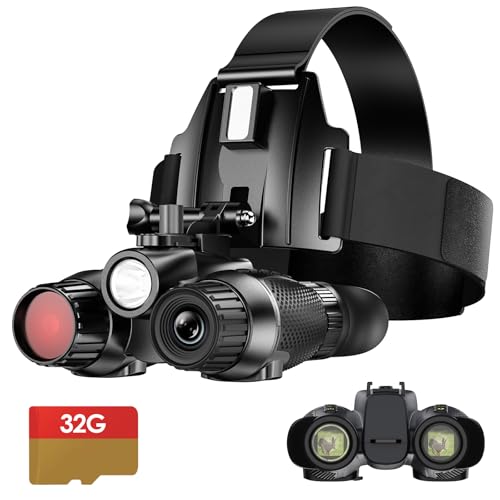
3D Head-Mounted Night Vision Goggles Review Summary
This 3D Head-Mounted Night Vision Goggles review points to a very specific buyer: someone who wants hands-free night observation with more immersion than a single-screen device can provide.
The listing leans hard into dual-screen 3D viewing, manual focus, 8x digital zoom, a white supplemental light, and helmet or headband mounting, so the product makes the most sense for hunting support, scouting, nocturnal observation, and documenting low-light outings.
Verdict: if you value wearable operation and a more binocular-like viewing experience, this is a plausible fit.
If you mainly want simple, portable, grab-and-go night vision, the feature set may be more than you need.
Review Scorecard
| Category | Score | Why it matters |
|---|---|---|
| Wearability | 9/10 | Headband and helmet adapter support hands-free use. |
| Night visibility control | 8/10 | 7-level IR adjustment and a white fill light give multiple ways to manage dim scenes. |
| Viewing experience | 8/10 | Dual-eyepiece 3D viewing is a differentiator for immersive observation. |
| Image and recording flexibility | 8/10 | The listing supports 36MP photos and ultra-high-definition video capture. |
| Ease of aiming and focus | 7/10 | Manual focus and diopter adjustment improve precision but add setup steps. |
| Portability | 6/10 | Wearable design helps in the field, but this is still a more specialized setup. |
| Buyer specificity | 9/10 | Strong fit for hunters, recon-style observation, and outdoor recording rather than casual users. |
Key Features and Specifications of 3D Head-Mounted Night Vision Goggles
The main draw is the combination of dual-screen, dual-eyepiece 3D viewing with a wearable mounting system.
The listing says the unit supports an adjustable headband and a helmet mount adapter, with compatibility for FAST and MICH helmets.
That immediately tells you this is built for hands-free work, not just bench-top viewing.
The product also emphasizes low-light control.
According to the listing, you can activate a white fill light by turning on an IR setting and pressing the WL/IR button.
There is also 7-level infrared adjustment via IR+ and IR- controls, which gives the user a way to tune brightness instead of relying on a single fixed night mode.
On the imaging side, the listing claims:
- 36MP photo capture
- ultra-high-definition video
- 4K high-definition video support
- 8x optical zoom
- multiple color effects, including color, fluorescent green, infrared light, and black-and-white
The viewing setup is more adjustable than a simple monocular.
The listing describes left/right eyepiece diopter adjustment plus manual focus, which should help users tune the image for their eyes and the viewing distance.
The product notes a best 3D experience when the eyes are close to the eyepieces, and it cites a shooting/viewing distance of 10 meters, or about 32 feet.
In plain terms, this is not a generic consumer gadget.
It is a specialized night-vision binocular system built around field observation, filming, and hands-free use.
Pros and Cons of 3D Head-Mounted Night Vision Goggles
Pros
- Hands-free operation is the biggest practical win. The headband and helmet adapter make it easier to keep both hands available.
- Dual-eyepiece 3D viewing should feel more natural than a single-screen setup for users who care about depth and immersion.
- Multiple low-light modes give you more control over how the scene looks, including infrared and black-and-white options.
- White fill light support adds flexibility when IR alone is not the right answer.
- Manual focus and diopter adjustment are useful for getting a sharper image for your eyes.
- Helmet compatibility makes it more serious than a casual backyard night-vision toy.
Cons
- It is specialized gear, so casual buyers may find it more complex than they need.
- Setup is less immediate than a simpler handheld night-vision device because focus, diopter, and IR settings all matter.
- 8x digital zoom can be useful, but buyers should still think of it as a tool for adjustment, not a substitute for larger optical systems.
- The field of view is listed as 10°FOV, which suggests a narrow, observation-focused experience rather than a broad scanning view.
- It depends on the right use case; if you only need occasional night checking, the wearable design may be overkill.
Who Should Buy 3D Head-Mounted Night Vision Goggles?
Buy this if you want hands-free night observation and you expect to spend time tuning the device for clarity.
It fits hunters, wildlife observers, search-style scouting, and outdoor users who want a wearable infrared system with recording capability.
It also makes sense for buyers who like gear that can mount to a helmet or sit on a headband.
That matters if you need stable viewing while moving, working, or keeping a device aligned for longer periods.
Skip it if you want the easiest possible night-vision product with almost no setup.
Skip it too if you do not care about 3D dual-eyepiece viewing, or if your main need is just quick check-ins around a campsite or property.
How the Viewing and Focus System Works
Dual-Eyepiece 3D Layout
The most distinctive part of the product is the dual-screen, dual-eyepiece layout.
The listing frames this as a naked-eye 3D effect, which suggests a more immersive presentation than a single-eye screen or monocular.
For buyers who dislike the fatigue or awkwardness of one-eye viewing, that is a real selling point.
IR and White Light Control
The IR controls are meant to let you brighten the image in dim conditions step by step rather than jumping between modes.
The white fill light adds another layer of flexibility, especially when the scene needs a different type of illumination.
That does not make the device magical in darkness, but it does mean the user has more control over the scene than with a fixed-light unit.
Focus, Diopter, and Distance
Manual focus and left/right diopter adjustment are important here because this product asks more of the user than a simple point-and-shoot device.
The listing explicitly recommends closing one eye at a time to tune each eyepiece, then using the manual focus wheel for the sharpest image.
That implies the best results come from deliberate setup, not casual use.
Recording and Field Use
The advertised 36MP photo and UHD/4K video support make the product more appealing to people who want to document what they see.
That can matter for hunters, scouts, or anyone comparing locations and conditions after the fact.
The practical value is not just seeing in the dark, but also keeping a record of what was observed.
Alternatives to 3D Head-Mounted Night Vision Goggles
If you want a simpler, more established night-vision route, look at BinoX night vision binoculars, Pulsar night vision binoculars, or Bushnell night vision binoculars.
Those lines are worth comparing if you want brand familiarity or a more conventional binocular format.
For a more tactical or helmet-oriented comparison, check night vision goggles helmet mount and infrared night vision binoculars.
Those searches can surface products that emphasize similar field use but with different ergonomics, display styles, or sensor approaches.
If your priority is budget-conscious experimentation, compare against digital night vision goggles.
That category often includes simpler user interfaces and more mainstream head-mounted options.
Is 3D Head-Mounted Night Vision Goggles Worth It?
Yes, if your buying decision is driven by hands-free use, wearable comfort, and a more immersive dual-eyepiece experience.
The listing gives it a coherent identity: head-mounted infrared night vision with white light support, manual focus, 7-level IR tuning, and recording-oriented specs.
It is less compelling if you want a no-fuss night-vision device for occasional use.
This is the kind of product that rewards a buyer who already knows they want wearable field gear and is willing to spend time adjusting focus and illumination for the scene.