RIX Titan-T3 Thermal Monocular LRF review is for buyers who want thermal imaging, ranging, and ballistic support in one compact unit.
If that is your use case, it is a serious option.
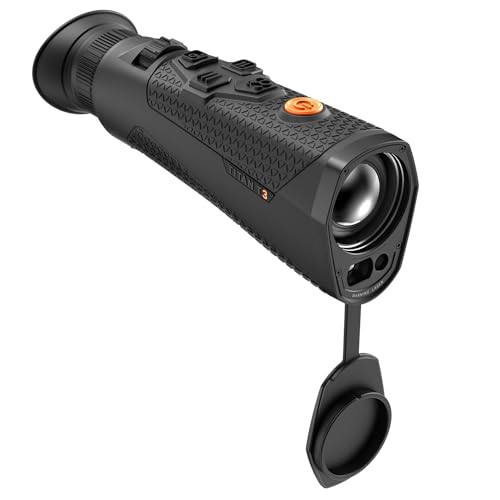
Titan-T3 Thermal Monocular Review Summary
The RIX Titan-T3 makes sense for hunters and outdoor users who want a thermal monocular that does more than simply show heat.
Its combination of a 25mm lens, 384×288 thermal resolution, integrated laser rangefinder, and free ballistic calculator gives it a broader job than a basic spotter, especially when target distance matters.
Verdict: strong fit for night hunting and distance-aware spotting. It is not a minimalist budget monocular, but the feature stack is clearly built for buyers who value identification, ranging, and steadier decision-making in the field.
Review Scorecard
| Category | Score | Rationale |
|---|---|---|
| Thermal imaging detail | 8/10 | 384×288 resolution and 12ÎĽm pixel pitch are solid for a compact monocular. |
| Distance utility | 9/10 | The integrated LRF measures out to 1312 yards, which is useful for field planning. |
| Display quality | 8/10 | The 1920×1080 OLED display should help with finer target presentation. |
| Ease of use | 8/10 | One-hand operation and near-eyepiece focus controls are practical in the dark. |
| Image stability | 8/10 | Electronic image stabilization is a meaningful advantage when movement or vehicle vibration is a factor. |
| Low-light performance | 9/10 | The F0.9 lens and thermal platform are both aligned with dark, humid, or low-visibility conditions. |
| Overall buyer fit | 9/10 | Best for users who want a feature-rich thermal monocular for hunting and serious spotting. |
Key Features and Specifications of Titan-T3 Thermal Monocular
The Titan-T3 is built around a 25mm objective lens and a 384×288 thermal sensor with a 12ÎĽm pixel pitch.
RIX also lists a 1920×1080 OLED display, NETD<20mK, and detection up to 1421 yards, which points to a device intended for practical field work rather than casual curiosity.
The biggest differentiator is the built-in laser rangefinder plus free integrated ballistic calculation.
That pairing matters if you are using thermal data to make decisions at varying distances instead of just locating heat signatures.
Other listed highlights include:
- 25mm F0.9 lens designed to gather more light than a typical F1.0 lens
- Integrated ballistic calculator
- Laser rangefinder with distance measurement up to 1312 yards
- 1920×1080 OLED display
- Electronic image stabilization
- One-hand operation with an ergonomic button layout
- RET technology that uses AI-assisted pixel enhancement during digital zoom
For a buyer, the spec sheet reads like a thermal tool aimed at real field use: fast setup, easier handling, more stable viewing, and a better chance of keeping usable detail when zooming or moving.
Pros and Cons of Titan-T3 Thermal Monocular
Pros
- Built-in LRF and ballistic calculator add real decision-making value
- OLED display resolution is higher than many basic thermal viewing screens
- One-hand operation should be helpful in field conditions
- EIS is useful when you are moving, riding, or dealing with vibration
- 25mm F0.9 lens is a strong match for low-light and humid conditions
Cons
- The spec set is specialized, so it may be more than casual users need
- Thermal resolution is good, but it is not a high-end jump beyond the class
- Buyers who only want a simple detector may not use the rangefinder or ballistic features enough to justify the complexity
Who Should Buy Titan-T3 Thermal Monocular?
Buy the Titan-T3 if you want a thermal monocular for hunting, spotting, and distance-aware observation.
It is especially compelling for users who care about range estimation and want the convenience of ballistic calculation in the same device.
It also makes sense for anyone working in dark, low-visibility, or vibration-prone environments where image stability and quick handling matter.
Skip it if you only need occasional thermal scanning, do not care about ranging, or prefer a simpler monocular with fewer functions to learn.
The Titan-T3 is clearly built for users who will actually use the extra tools.
Thermal Performance and Field Use
Rangefinding and Ballistics
The integrated LRF is the main reason this model stands out.
If you are trying to judge a live target or terrain feature at distance, the ability to measure out to 1312 yards is more useful than a thermal-only view.
Display and Image Clarity
The 1920×1080 OLED display should help the Titan-T3 present thermal data more clearly than a lower-resolution panel.
That matters most when you need to separate similar shapes, not just detect obvious heat.
Stability and Handling
Electronic image stabilization and one-hand operation make the Titan-T3 easier to live with in motion.
That is a practical advantage for field users who do not always have a stable rest or perfect viewing posture.
Zoom and Detail Recovery
RIX says its RET technology uses AI to enhance pixel details during digital zoom.
That does not replace native sensor detail, but it does suggest the company is trying to keep zoomed views more usable than a blunt digital crop.
Alternatives to Titan-T3 Thermal Monocular
If you want to compare before buying, look at other thermal monocular families on Amazon that target similar field use:
Those are credible comparison points because they cover the same broad category: handheld thermal viewing for hunting, scouting, and outdoor observation.
The right alternative depends on whether you care more about sensor class, ergonomics, rangefinding, or software features.
Is Titan-T3 Thermal Monocular Worth It?
Yes, if you want a feature-rich thermal monocular with a built-in rangefinder and ballistic support.
The RIX Titan-T3 is most worth it for hunting and serious field use, not for casual thermal curiosity.
If those capabilities match your workflow, it is a sensible buy.
If you will not use the extra tools, a simpler thermal monocular is the better choice.