If you are looking for a compact Jackery Explorer 240D Power Bank review, the key question is simple: does this small power station actually cover the devices people carry every day?
Based on the listing, it is built for that job with a strong mix of portability, DC output, and fast recharge support.
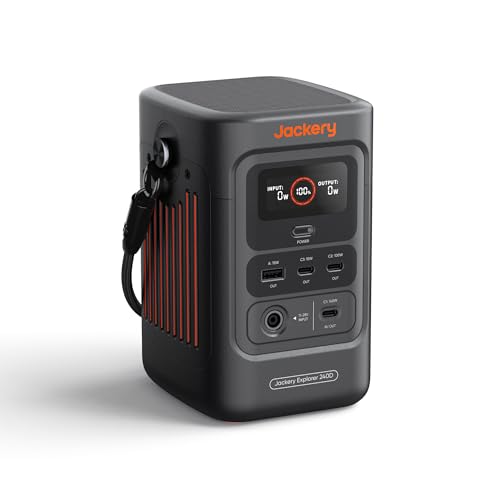
Explorer 240D Review Summary
The Jackery Explorer 240D Power Bank makes sense for buyers who want a small, easy-to-carry backup power source instead of a bulky all-purpose station.
Its value is not in running heavy appliances; it is in giving campers, travelers, and emergency planners a compact way to charge several personal devices at once while keeping the unit light and packable.
The listing points to a clear product identity: 256Wh of energy, four ports, up to 200W pure DC output, and LiFePO4 battery chemistry.
That combination suggests a power bank designed around practical portable charging, not campsite overkill.
If your gear is mostly USB-powered, this model is aimed directly at you.
Review Scorecard
| Category | Score | Why it scores this way |
|---|---|---|
| Portability | 9/10 | At about 4.85 lbs and compact dimensions, it is built for carry-on style convenience. |
| Everyday Charging Flexibility | 8/10 | Three USB-C ports and one USB-A port cover common devices cleanly. |
| Output Headroom | 7/10 | 200W DC output is strong for personal electronics, but not for large loads. |
| Recharge Convenience | 8/10 | AC-DC dual input and solar/car charging options add practical flexibility. |
| Battery Durability | 9/10 | The LiFePO4 design and 6,000-cycle claim point to long-term value. |
| Emergency Readiness | 8/10 | Fast recharge claims and multiple input methods support backup use. |
| Overall Fit | 8/10 | Best for compact portable power buyers, less so for high-wattage household backup. |
Key Features and Specifications of Explorer 240D
The strongest selling point is the size-to-output balance.
The product is listed at 256Wh with 200W pure DC output, and it can power up to four devices at once through 3 USB-C ports and 1 USB-A port.
That is a useful spread for phones, tablets, cameras, lights, and similar gear.
The unit also comes with a 2-in-1 USB-C strap cable, which doubles as a carrying strap and a fast-charging cable.
That is a smart design choice for a product meant to be moved often.
Other listing facts that matter:
- Battery type: LiFePO4 lithium battery
- Lifespan claim: up to 10 years, with 70% remaining energy after 6,000 charge cycles
- Weight: about 4.85 to 4.9 pounds
- Dimensions: 4.73 x 4.19 x 6.69 inches
- Charging options: USB-C, solar, car charging, and AC-DC dual input
- Fast charging claim: up to 80% in one hour with a 100W charger
- Solar input support: up to 100W
- Use cases mentioned by the listing: camping, outdoor activities, road trips, backup power, and emergencies
Those specs position the Explorer 240D as a portable DC-first power bank.
It is not pretending to be a home generator replacement.
That honesty is a plus because it helps buyers judge the product by what it is actually built to do.
Pros and Cons of Explorer 240D
Pros
- Compact and relatively light for a 256Wh unit
- Four-device charging makes it convenient for shared travel use
- USB-C-heavy port layout matches modern device needs
- LiFePO4 battery chemistry supports long-term durability
- Fast charging and solar support improve real-world usefulness
- Included strap cable adds portability and reduces carry friction
Cons
- 200W output is limited for buyers who want to power bigger equipment
- DC-focused design will not suit people expecting AC outlet versatility
- Best value depends on USB-C devices; legacy-device households may feel less served
- Emergency backup scope is narrow compared with larger power stations
The tradeoff is straightforward.
You get a highly portable unit with modern charging behavior, but you give up the broad utility of larger stations.
That is a reasonable compromise if your actual priority is mobility.
Who Should Buy Explorer 240D?
This product fits campers, hikers, frequent travelers, and commuters who want to keep phones and small electronics charged without hauling a heavy box.
It also makes sense for anyone building a practical emergency kit around USB-powered essentials.
It is especially appealing if you already rely on USB-C gear.
The port mix, the included cable, and the fast-charge positioning all point toward a user who values convenience and speed over raw output.
You should probably skip it if you need:
- A power source for kitchen appliances or high-draw tools
- A station with AC outlets as a core requirement
- A large-capacity backup solution for extended outages
- A single unit meant to cover both light devices and heavier home loads
In other words, the Explorer 240D is for portable personal power, not whole-house resilience.
Buyers who understand that boundary are the ones most likely to be satisfied.
Portability and Charging Behavior of Explorer 240D
Carry-Friendly Form Factor
The listed weight and dimensions make this model easier to pack than many larger stations.
That matters because a power bank only feels useful if you actually bring it along.
The Explorer 240D seems designed around that reality.
Device Coverage
With three USB-C ports and one USB-A port, the unit is set up for modern mixed-device charging.
That is useful for families or solo travelers who carry several items that all need topping up during the day.
Recharge Paths
The ability to recharge from AC-DC dual input, solar, car charging, or USB-C gives the Explorer 240D strong flexibility.
The one-hour to 80% claim with a 100W charger is particularly relevant for users who need quick turnaround before leaving camp or heading out again.
Long-Term Battery Use
The LiFePO4 battery and 6,000-cycle durability claim suggest that Jackery is aiming this at buyers who want a product to last through repeated trips and seasonal emergency use.
That durability angle is one of the most persuasive parts of the listing.
Alternatives to Explorer 240D
If you want to compare the Explorer 240D with other portable power options, these Amazon search pages are the most relevant starting points:
Those alternatives are worth checking if you want a different balance of battery size, output style, and portability.
Jackery’s own lineup is the closest comparison if you want to stay with the brand, while EcoFlow, Anker, and BLUETTI are credible cross-brand options for shoppers comparing compact power stations.
Is Explorer 240D Worth It?
Yes, if you want a compact, durable, USB-friendly power bank for travel, camping, and emergency charging.
The Explorer 240D’s value comes from its portable size, LiFePO4 battery, four-device output, and flexible recharge options.
It is not the right buy if you need AC-heavy output or a larger backup system for more demanding gear.
But if your use case is small electronics, grab-and-go power, and long-term reliability, the Jackery Explorer 240D looks like a well-targeted purchase.