Getting your board to the recommended pressure should be quick and predictable, not a tiring pre-launch chore. The right electric pump can save time, reduce effort, and help you reach a consistent PSI before heading onto the water.
We selected 10 paddleboard pumps with practical features such as dual-stage inflation, automatic shutoff, rechargeable batteries, car power, and deflation support. Use the guide below to match pump performance and power options to your paddling routine.
Best 10 Paddleboard Pumps Picks for 2026
Best Overall

- 20 PSI dual-stage inflation with auto-off
- Active cooling for up to three boards
- 12V car power, deflation, and digital display
Best For: Vehicle-based paddlers inflating multiple boards
Best Portable Pick

- Lightweight 2.78-pound battery-powered design
- Inflates to 15 PSI in about 9.5 minutes
- Digital accuracy, auto-off, deflation, and seven nozzles
Best For: Portable paddleboarding away from a car
Best Cordless Performance

- Inflates a 10.6-foot board to 15 PSI in 3:50
- 74Wh battery rated for four SUPs
- Type-C and vehicle input with 20 PSI auto-off
Best For: Fast group setup without relying solely on a car
Best Budget Car Pump
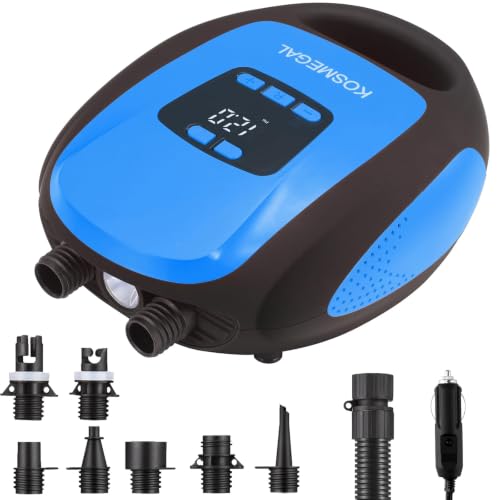
- 12V car-powered inflation with automatic shutoff
- Backlit LCD and flashlight for low-light use
- Six nozzles, deflation function, and carry bag
Best For: Car-accessible launches on a budget
Best Balanced Pick
WEOLULI 22 PSI Paddleboard Pump

- 22 PSI output with auto shutoff
- Rechargeable battery plus 12V car power
- Handles up to eight boards per session
Best For: Portable, repeat-use SUP inflation
Best High-Pressure Option

- 50 PSI maximum with dual-stage motor
- 10,000mAh battery and 12V backup
- Inflation, deflation, and tire modes
Best For: Fast, versatile inflation for boards and tires
Best for Long Sessions

- 13,500mAh battery for multiple boards
- Dual-stage inflation up to 15 PSI
- Cooling system and emergency LED light
Best For: Group launches and extended outings
Best Lightweight Electric Pick

- 12V car-powered operation
- LCD pressure display with inflation and deflation
- Six adapters and compact 4-pound design
Best For: Car-accessible SUP launches and general inflatable gear
Best Fast-Filling Option

- Dual-stage airflow up to 360 L/min
- Auto shutoff with pressure preset and PSI/BAR display
- Seven nozzles and 12V car connection
Best For: Fast, repeatable inflation at car-accessible launch points
Best Multi-Purpose Pick

- 50 PSI capacity with SUP and car-tire modes
- Auto-off inflation and timed deflation
- 10-foot cable, eight adapters, and emergency light
Best For: Road trips requiring SUP and tire inflation in one pump
Best Overall – OutdoorMaster Shark 2
For shoppers comparing paddleboard pumps, the OutdoorMaster Shark 2 is a capable corded option with dual-stage inflation, automatic shutoff, and a digital pressure display. It connects to a 12V car outlet and is designed to inflate a 10.6-foot board to 15 PSI in about 12 minutes.
Best For: Paddlers who want a reliable car-powered pump for inflating multiple boards.
Pros:
- Active cooling system supports inflation of up to three boards in a row.
- Dual-stage operation combines 350 L/min speed with 70 L/min high-pressure output.
- Auto-off, real-time pressure monitoring, deflation, and multiple nozzles add versatility.
Cons:
- Requires access to a 12V DC car connector.
- Listed operating sound is 85 dB.
- At 3.6 pounds, it is heavier than some compact alternatives.
The Shark 2 is a practical choice for vehicle-based launches, especially when cooling and repeated inflation matter more than cordless portability.
Best Portable Pick – AIRBANK Puffer Pro
The AIRBANK Puffer Pro stands out among paddleboard pumps for its compact, battery-powered design. It weighs 2.78 pounds, includes a storage bag and strap handle, and combines fast dual-stage inflation with precise digital pressure monitoring.
Best For: Paddlers who need a lightweight pump for trips away from a vehicle.
Pros:
- Battery-powered design is easy to carry, with a compact body, strap handle, and bag.
- Inflates a 10.6-foot board to 12 PSI in about 7.5 minutes and to 15 PSI in about 9.5 minutes.
- 20 PSI capacity, auto-off, deflation, lighting, and seven nozzles support varied inflatables.
Cons:
- Battery runtime depends on the charging state and usage conditions.
- The pump is still an electric device rather than a manual backup.
With its portable battery-powered format and stated pressure-reading accuracy of ±0.2 PSI, the Puffer Pro is well suited to organized, convenient setup at the water.
Best Cordless Performance – OutdoorMaster Shark 3
If speed and cordless convenience are priorities when comparing paddleboard pumps, the rechargeable OutdoorMaster Shark 3 is worth a look. Its 74Wh battery is rated for four 10.6-foot boards at 15 PSI, while the pump can also use Type-C or 12V/15.8V DC input.
Best For: Paddlers who want fast inflation and enough battery capacity for a group session.
Pros:
- Inflates a 10.6-foot board to 15 PSI in about 3 minutes 50 seconds and deflates it in about 1 minute 20 seconds.
- 74Wh battery is rated for up to four boards on one charge.
- Supports 20 PSI, auto-off, digital monitoring, eight nozzles, and emergency phone charging.
Cons:
- Weighs about 3.64 kg, making it heavier than the Puffer Pro.
- High-pressure operation can reach 88 dB.
- Recharge time through Type-C is listed at about 1 hour 40 minutes.
The Shark 3 is a strong cordless choice when rapid setup and multi-board capacity justify carrying a larger pump.
Best Budget Car Pump – KOSMEGAL SUP Pump
The KOSMEGAL SUP Pump is a straightforward option for paddleboard pumps when you typically inflate beside a running vehicle. It uses a 12V DC car connector, offers automatic shutoff at the selected pressure, and includes a backlit display, flashlight, deflation function, and carry bag.
Best For: Budget-minded paddlers who launch near their vehicle.
Pros:
- Automatic shutoff helps stop inflation at the selected pressure.
- Large backlit LCD and integrated flashlight support nighttime use.
- Six nozzles and a carry bag accommodate SUPs and other inflatables.
Cons:
- It is not rechargeable and must remain connected to a started vehicle.
- The product notes recommend 10 PSI for SUP use and list a 15 PSI maximum.
- Deflation must be turned off manually.
This pump makes the most sense for car-accessible launches where a compact, organized kit matters more than cordless operation or the highest stated SUP pressure.
Best Balanced Pick – WEOLULI 22 PSI Paddleboard Pump
If you want paddleboard pumps that balance portability, power, and backup options, the WEOLULI is a practical choice. Its 22 PSI output, rechargeable battery, and 12V car connection make it useful at both convenient and remote launch points.
Best For: Paddlers who want a lightweight pump for repeated inflation sessions and varied inflatable gear.
Pros:
- Dual power supply supports the built-in battery or a 12V car connection.
- Can handle up to eight paddle boards in one session, according to the supplied notes.
- Automatically shuts off at the selected pressure and includes real-time pressure monitoring.
- Includes seven nozzle adapters, deflation, a flashlight, and an emergency charging port.
Cons:
- Inflating a 10.5-foot SUP to 12 PSI takes about 8.5 minutes.
- The pressure sensor may require calibration if it displays a nonzero reading before use.
At 2.73 pounds and 7 by 6 by 3 inches, this is a particularly portable option. It is a strong fit when convenience and session endurance matter more than maximum pressure.
Best High-Pressure Option – 50 PSI Rechargeable SUP Pump
Among paddleboard pumps, this model stands out for its 50 PSI maximum and dual-stage motor. It is designed to inflate a 10.6-foot board to 12 PSI in about six minutes, while also providing deflation and tire-inflation modes.
Best For: Users who prioritize faster inflation, a larger battery, and one pump for boards, kayaks, and tires.
Pros:
- 50 PSI maximum pressure and dual-stage inflation support faster setup.
- Built-in 10,000mAh battery can inflate up to four paddle boards on one charge, per the notes.
- Offers 12V DC backup power, Type-C charging, inflation, deflation, and tire modes.
- Large LED display, auto shutoff, and emergency light add practical convenience.
Cons:
- The supplied notes do not provide the pump’s weight or physical dimensions.
- Its battery capacity is specified for up to four boards, fewer than some higher-capacity alternatives.
This is the performance-focused pick in the group. The combination of high-pressure capability, roughly six-minute inflation to 12 PSI, and multiple operating modes makes it versatile for water sports and roadside use.
Best for Long Sessions – 13500mAh Dual-Motor SUP Pump
For shoppers comparing paddleboard pumps for extended outings, this model emphasizes battery capacity and sustained operation. Its 13,500mAh battery can continuously inflate three SUPs to 15 PSI or four to 12 PSI, and it also works from a 12V DC car adapter.
Best For: Groups or frequent paddlers who need higher battery capacity for multiple boards.
Pros:
- Large 13,500mAh battery supports multiple board inflations per charge.
- Dual-motor design delivers 360 L/min in the first stage and 100 L/min in the second.
- Preset pressure, real-time monitoring, and automatic shutoff simplify inflation.
- Includes deflation, cooling, noise reduction, and a nine-hour LED emergency light.
Cons:
- Inflation takes about seven minutes to 10 PSI and 11 minutes to 15 PSI on the tested board.
- The supplied notes say deflation must be stopped manually.
- The 12V adapter powers the pump but does not charge its battery.
This pump favors capacity over the quickest stated inflation time. Its battery endurance and cooling system make it a sensible choice for group launches, while the 12V option provides a useful power fallback.
Best Lightweight Electric Pick – 20 PSI SUP Pump
For shoppers comparing paddleboard pumps, this compact 20 PSI electric model is a practical choice when you want to inflate from your vehicle without hand pumping. It connects to a 12V car socket, displays live pressure on an LCD screen, and includes inflation and deflation functions.
Best For: Paddlers who want a lightweight, car-powered pump for SUPs and other inflatables.
Pros:
- Inflates a regular paddle board in about 10–15 minutes and deflates it in about 3 minutes.
- LCD pressure display and button controls support real-time monitoring.
- Includes six adapters for paddle boards, mats, floating pads, and other inflatables.
- Compact 4-pound design with a 3.4-meter vehicle power cord.
Cons:
- Requires connection to a vehicle’s 12V cigarette-lighter socket.
- Its 20 PSI maximum is intended for standard inflatable gear rather than higher-pressure applications.
This pump stands out for its portable size, straightforward controls, and useful deflation mode. It is a sensible option for car-accessible launches where convenience matters more than cordless operation.
Best Fast-Filling Option – Dual-Stage 20 PSI SUP Pump
This paddleboard pump uses a dual-stage system to move quickly through initial filling before switching to high-pressure inflation. It connects directly to a 12V car socket, offers preset pressure with automatic shutoff, and is designed for repeated outdoor use.
Best For: Paddlers who prioritize faster inflation, pressure consistency, and repeated car-based use.
Pros:
- Stage 1 delivers up to 360 L/min, while Stage 2 supports accurate inflation up to 20 PSI.
- Can inflate an 11-foot SUP to 12 PSI in about six minutes under stated conditions.
- Preset pressure, PSI/BAR switching, and automatic shutoff simplify operation.
- Includes seven nozzles, an O-ring, storage bag, and a 3-meter 12V power cable.
Cons:
- Has no built-in battery and must remain connected to a 12V car socket.
- Continuous operation is limited to about 35 minutes.
With its fast first stage, pressure-focused second stage, and auto-off feature, this is one of the more convenience-oriented options in the group. The lack of battery power is the main limitation, so it is best suited to launches near a vehicle.
Best Multi-Purpose Pick – 50 PSI SUP and Tire Pump
If you want paddleboard pumps that can also handle vehicle emergencies, this 12V model adds a car-tire mode to its SUP and deflation settings. It reaches up to 50 PSI, automatically stops at the selected pressure, and includes a long power cable, tire hose, and eight adapters.
Best For: Outdoor users seeking one car-powered pump for paddle boards, inflatables, bicycles, and car tires.
Pros:
- 50 PSI maximum pressure supports both SUP inflation and car-tire applications.
- Dedicated SUP, car-tire, and deflation modes provide broad functionality.
- Auto-off protection stops inflation at the selected pressure and ends deflation after 150 seconds.
- Includes a 10-foot power cable, tire hose, eight adapters, and an LED emergency light with SOS modes.
Cons:
- Requires a 12V DC cigarette-lighter connection rather than battery power.
- The higher-pressure, multi-purpose design may be more capability than needed for SUP-only use.
This is the most versatile choice of the three, particularly for road trips where tire and inflatable support from one device is useful. Its 50 PSI rating and emergency lighting add flexibility, while the corded design keeps it dependent on a vehicle.
How We Picked These Paddleboard Pumps
We focused on the features that matter most when inflating a stand-up paddleboard: maximum pressure, inflation speed, power source, portability, controls, and included valve adapters. Models with dual-stage operation were given particular attention because they can move from fast, low-pressure inflation to slower high-pressure finishing without requiring a separate pump.
Automatic shutoff is another important convenience. It helps prevent overinflation when the correct PSI is known, while digital displays or clear controls make it easier to monitor progress. We also considered whether each pump supports deflation, which can simplify packing an inflatable board after a session.
Quick Comparison
| Feature | Why It Matters |
|---|---|
| Maximum pressure | Most inflatable SUPs need roughly 12–20 PSI; higher ratings provide extra headroom but do not necessarily mean faster inflation. |
| Power source | Rechargeable pumps suit remote launches, while 12V car-powered models are dependable for road trips and extended use. |
| Dual-stage inflation | Combines faster initial filling with higher-pressure finishing. |
| Auto shutoff | Stops the pump at the selected pressure and reduces the risk of overinflation. |
| Deflation mode | Pulls air from the board to make rolling and storage easier. |
Key Buying Factors for Paddleboard Pumps
Pressure and Compatibility
Check your board’s recommended PSI and confirm that the pump includes a compatible Halkey-Roberts-style or manufacturer-specified valve adapter. A 20 PSI pump is suitable for most SUPs. A 50 PSI rating is useful only if you also plan to inflate other equipment that requires higher pressure.
Battery Life and Power
Rechargeable models are convenient for beaches, lakes, and launch sites without outlets, but battery capacity affects how many boards you can inflate per charge. For several boards or frequent use, a 12V car connector can provide a more dependable power source. Some pumps offer both options.
Noise, Size, and Speed
Electric pumps are rarely silent, so consider where you will inflate and whether a compact design is easy to carry with your board. Dual-stage systems generally offer a good balance between quick initial inflation and efficient high-pressure operation.
Controls and Accessories
Look for readable pressure displays, simple PSI adjustment, automatic shutoff, secure connectors, and a storage bag. Multiple nozzles can increase versatility, but the SUP valve adapter is the essential accessory.
Who Should Buy Which Paddleboard Pumps?
Choose a rechargeable pump if you usually launch away from your vehicle. Pick a car-powered model for dependable repeated inflation, long road trips, or multiple boards. A dual-stage pump is the best all-around choice for faster setup, while a model with deflation is especially useful for paddlers who pack their board immediately after use. If portability is your top priority, favor a compact pump with a built-in battery; if speed and repeated use matter more, prioritize power capacity and 12V compatibility.