Inflating a stand-up paddleboard by hand can take time and energy before you even reach the water. The best electric SUP pumps make setup easier by combining high-pressure performance, automatic shutoff, and convenient power options.
We compared 10 paddleboard pumps under $300, including rechargeable models and 12V car-powered designs, to help you find the right balance of speed, portability, battery life, and value.
Best 10 Paddleboard Pumps Under 300 Picks for 2026
Best Lightweight Pick

- 2.78-pound portable design
- 20 PSI dual-stage inflation
- Seven nozzles and auto-off
Best For: Portable SUP setup with precise pressure control
Best Battery Capacity

- 74Wh battery for up to four SUPs
- 3:50 claimed inflation time
- Type-C and 12V/15.8V inputs
Best For: Group outings and extended trips
Best Compact Value
Hydrohero Rechargeable SUP Pump

- 2.51-pound portable body
- Five-minute claimed inflation to 12 PSI
- 30W Type-C fast charging
Best For: Solo paddlers seeking a light, fast pump
Best Dual-Power Option

- 6000mAh rechargeable battery
- 12V DC backup power
- LCD control with ±0.1 PSI claim
Best For: Camping, RV travel, and vehicle-supported adventures
Best High-Pressure Battery Pump

- 10000mAh battery inflates up to four boards
- 12V backup, auto-off, and real-time pressure display
- Inflates, deflates, and supports tire mode
Best For: Frequent paddlers needing cordless, high-pressure operation
Best for Extended Sessions
WEOLULI 22 PSI Portable SUP Pump

- 7800mAh battery plus direct 12V car power
- Designed to handle up to eight boards per session
- Lightweight body with auto-off, deflation, and seven adapters
Best For: Group outings and repeated inflations
Best Car-Powered Value
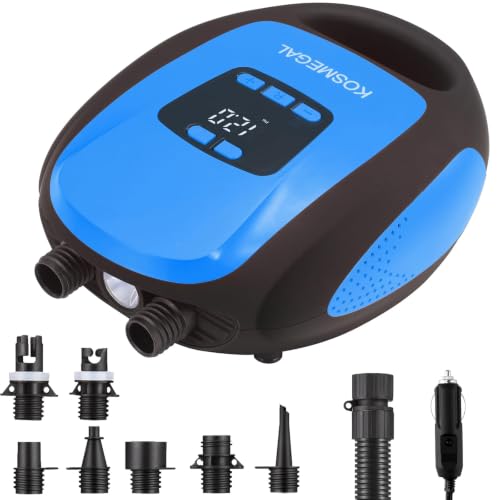
- 12V car-powered operation with no rechargeable battery
- Backlit display supports four pressure units
- Six nozzles, auto-off, deflation, flashlight, and carry bag
Best For: Car-based launches and straightforward SUP inflation
Best Car-Powered Pick

- Dual-stage inflation reaches 20 PSI
- Preset pressure with auto shutoff
- Includes seven nozzles and a 3 m cable
Best For: Paddlers who prefer dependable 12V vehicle power
Best Heavy-Duty Pick
Portable 20 PSI Electric SUP Pump

- Inflates and deflates inflatables
- Digital display shows current pressure
- Compact 4-pound design with six adapters
Best For: Casual paddlers seeking a portable car-powered pump
Most Versatile Pick

- Supports SUP, tire, and deflation modes
- Reaches up to 50 PSI
- Includes 10 ft cable and eight adapters
Best For: Users needing one pump for boards and vehicle tires
Best Lightweight Pick – AIRBANK Puffer Pro
For shoppers comparing paddleboard pumps under 300, the AIRBANK Puffer Pro stands out as a compact rechargeable option with dual-stage inflation, automatic shutoff, and a claimed 20 PSI maximum. It weighs just 2.78 pounds and includes a storage bag, hose, and seven nozzles.
Best For: Paddlers who prioritize portability, accurate pressure readings, and broad nozzle compatibility.
Pros:
- Lightweight 2.78-pound design with a carry handle and storage bag.
- Dual-stage operation can inflate a 10.6-foot board to 12 PSI in 7.5 minutes.
- Digital display, automatic shutoff, deflation, and claimed ±0.2 PSI reading accuracy.
- Seven nozzles support SUPs, kayaks, wing foils, kites, and other inflatables.
Cons:
- The supplied notes do not specify the battery capacity or number of boards per charge.
- Charging and power-input details are not provided.
The Puffer Pro is a strong fit when packability and pressure control matter most. Its claimed two-year manufacturer warranty and included accessories add practical value for regular water-sports use.
Best Battery Capacity – OutdoorMaster Shark 3
Among paddleboard pumps under 300, the OutdoorMaster Shark 3 is designed for group outings, with a 74Wh rechargeable battery rated for up to four 10.6-foot boards at 15 PSI. It also supports Type-C fast charging and a 12V/15.8V DC connection.
Best For: Families, groups, and travelers who need several board inflations away from a wall outlet.
Pros:
- 74Wh battery is rated for inflating four 10.6-foot SUPs to 15 PSI.
- Fast claimed inflation time of 3 minutes 50 seconds and deflation time of 1 minute 20 seconds.
- Type-C and vehicle DC input options provide charging flexibility.
- 20 PSI maximum, digital display, automatic shutoff, cooling system, and eight nozzles.
Cons:
- Its 3.2 kg listed weight is heavier than the more compact alternatives.
- The notes report noise up to 88 dB during high-pressure inflation.
- Warranty coverage is listed as one year.
The Shark 3 makes the most sense when battery endurance and speed outweigh low weight. Its emergency phone-charging function is a useful extra, while the vehicle input can extend use after the internal battery is depleted.
Best Compact Value – Hydrohero Rechargeable SUP Pump
The Hydrohero is a practical contender among paddleboard pumps under 300, combining a 2.51-pound body with a 20 PSI maximum, dual-stage operation, and a rechargeable 38.48Wh battery. It claims a 10.5-foot SUP can reach 12 PSI in five minutes.
Best For: Individual paddlers who want a lightweight pump with fast charging and simple automatic operation.
Pros:
- Lightweight 2.51-pound design with a built-in nylon handle and waterproof storage bag.
- Claims five-minute inflation to 12 PSI for a 10.5-foot SUP.
- QC3.0 30W fast charging through a Type-C port.
- Digital LED display, three modes, automatic shutoff, deflation, and seven nozzles.
Cons:
- A charger is not included; the notes recommend a supply supporting at least 5V/2A.
- The battery is rated for three boards to 12 PSI or two to 15 PSI per full charge.
Hydrohero balances portability, speed, and useful included accessories. Its battery capacity is more limited than the OutdoorMaster’s, but the lower weight and claimed two-year manufacturer guarantee make it appealing for personal SUP use.
Best Dual-Power Option – Seesii Cordless SUP Pump
For buyers searching paddleboard pumps under 300, the Seesii Cordless Pump offers both a 6000mAh rechargeable battery and 12V DC operation. Its two-stage system reaches up to 20 PSI, while the LCD screen supports preset pressure, auto-stop, and PSI/bar switching.
Best For: Campers, RV travelers, and paddlers who want cordless convenience with a vehicle-power backup.
Pros:
- Dual-power design combines a rechargeable battery with 12V DC input.
- 6000mAh battery is rated for up to four boards to 12 PSI or two to 15 PSI.
- Two-stage 400L/min and 100L/min operation supports faster high-volume inflation.
- LCD display, claimed ±0.1 PSI accuracy, auto-stop, inflation, and deflation modes.
Cons:
- The listed weight is 5.5 pounds, making it the heaviest option in this group.
- Battery charging is listed at about three hours.
- The supplied notes specify three adapters, fewer than some competing models.
The Seesii is a versatile choice for trips where access to a 12V outlet may be useful. It trades some portability for flexible power options, organized hose and cord storage, and a battery sized for multiple inflations.
Best High-Pressure Battery Pump – 50 PSI Rechargeable SUP Pump
For shoppers comparing paddleboard pumps under 300, this rechargeable electric model stands out for its 50 PSI maximum pressure, cordless operation, and 12V backup power. It can inflate a 10.6-foot paddle board to 12 PSI in about six minutes, with automatic shutoff and real-time pressure monitoring for convenient setup.
Best For: Paddlers who want a high-pressure pump that can handle multiple boards and work away from a vehicle.
Pros:
- 10000mAh battery can inflate up to four paddle boards per charge.
- Supports battery power, Type-C charging, and continuous 12V DC operation.
- Offers inflation, deflation, tire mode, auto-off, and seven nozzle adapters.
- Built-in LED includes white, warning-flash, and SOS modes.
Cons:
- Requires a 3.5–4.5-hour recharge for the built-in battery.
- Plastic construction may be less rugged than a metal-bodied pump.
Its combination of cordless convenience, high pressure, and versatile accessories makes it a strong all-around choice for frequent paddleboard use, especially when you do not want to stay next to a car.
Best for Extended Sessions – WEOLULI 22 PSI Portable SUP Pump
Among paddleboard pumps under 300, the WEOLULI combines a 7800mAh rechargeable battery with direct 12V car power. Its 22 PSI maximum, metal internal structure, and claimed ability to handle up to eight boards in one session make it a practical option for group outings or repeated inflations.
Best For: Families, groups, and paddlers who need a compact pump for several inflations in one outing.
Pros:
- Dual power supply reduces concern about battery depletion.
- Metal internal structure is designed for heat dissipation and extended use.
- Automatic shutoff, digital pressure display, deflation, and built-in flashlight add convenience.
- Lightweight 2.73-pound body includes a handle, storage bag, and seven adapters.
Cons:
- Its 22 PSI maximum is lower than the 50 PSI option in this roundup.
- The pressure sensor may need calibration if it displays a non-zero reading without a tube attached.
This model prioritizes endurance and portability over maximum pressure. The battery-and-car-power combination is particularly useful when multiple boards or inflatables need attention at the launch site.
Best Car-Powered Value – KOSMEGAL 20 PSI SUP Pump
For buyers seeking paddleboard pumps under 300, the KOSMEGAL is a straightforward car-powered electric inflator with a 20 PSI maximum, preset-pressure auto-off, and a 12V connector. It is designed for use at the vehicle rather than as a cordless pump, so the car must be running during operation.
Best For: Drivers who want a compact, budget-oriented SUP pump for use beside a started vehicle.
Pros:
- 12V car connection provides a simple power source without battery charging.
- Large backlit LCD supports PSI, KPa, BAR, and KG/CM² settings.
- Automatic shutoff stops inflation at the selected pressure.
- Includes six nozzles, deflation functionality, flashlight, and carry bag.
Cons:
- Not rechargeable and cannot be used independently of a running vehicle.
- Recommended SUP pressure is 10 PSI, with a stated maximum of 15 PSI, despite the 20 PSI pump rating.
- Deflation must be turned off manually.
The KOSMEGAL keeps things simple for car-based launches. Its controls and accessories are useful, but the lack of cordless power makes it less flexible than the rechargeable alternatives.
Best Car-Powered Pick – Dual-Stage 20 PSI SUP Pump
For shoppers comparing paddleboard pumps under 300, this model is a practical choice if you have access to a 12-volt vehicle socket. Its dual-stage system provides fast airflow for initial inflation, then switches to higher-pressure filling with preset controls and automatic shutoff.
Best For: Paddlers who want reliable car-powered inflation without managing a rechargeable battery.
Pros:
- Dual-stage inflation reaches up to 20 PSI, with a stated 360 L/min first stage and 100 L/min second stage.
- Preset pressure, digital display, PSI/BAR switching, and automatic shutoff simplify inflation.
- Includes seven nozzles, a 3 m car cable, storage bag, and SUP adapter for broader compatibility.
- Designed for about 35 minutes of continuous work and tested for more than 500 inflation and deflation cycles.
Cons:
- It must remain connected to a 12-volt car socket and has no built-in battery.
- Vehicle access is required for operation.
This is a strong fit for road trips and repeated setup sessions where consistent direct power matters more than cordless portability. The automatic shutoff and wide adapter selection add convenience for SUPs and other inflatables.
Best Heavy-Duty Pick – Portable 20 PSI Electric SUP Pump
Among paddleboard pumps under 300, this compact corded model emphasizes straightforward vehicle-powered inflation and portability. It reaches up to 20 PSI, includes inflation and deflation functions, and uses a digital display to show current pressure while you work.
Best For: Casual paddlers who want a lightweight electric pump for SUPs, kayaks, boats, and air mattresses.
Pros:
- Inflates a regular paddle board in a stated 10–15 minutes and can fully deflate it in about 3 minutes.
- Digital pressure display provides real-time monitoring.
- At 4 pounds and 9.8 by 6.9 by 6.1 inches, it is relatively easy to carry.
- Six adapters support several inflatable products.
Cons:
- It is powered through a car cigarette lighter and does not offer cordless operation.
- The listed hose length is 1 meter, which may provide less setup flexibility than longer-cable designs.
This pump keeps the feature set focused: vehicle power, automatic operation, pressure monitoring, and basic accessory coverage. It is worth considering when low carrying weight and simple setup are higher priorities than maximum versatility.
Most Versatile Pick – 50 PSI SUP and Tire Pump
For those comparing paddleboard pumps under 300 and wanting one device for more than SUP inflation, this 12V model adds car-tire capability to its paddleboard functions. It offers SUP, car-tire, and deflation modes, with automatic shutoff and a digital display for setting target pressure.
Best For: Outdoor users who want a multipurpose pump for paddle boards, inflatables, bicycles, and car tires.
Pros:
- Supports pressures up to 50 PSI and is rated for inflating a car tire to 36 PSI in about 2.5 minutes.
- Three operating modes cover SUP inflation, tire inflation, and deflation.
- Automatic shutoff helps stop inflation at the selected pressure; deflation shuts off after 150 seconds.
- Includes an LED display, emergency lighting modes, a 10 ft power cable, tire hose, and eight adapters.
Cons:
- It requires a 12V DC car cigarette lighter socket.
- The higher-pressure capability may be more than needed for shoppers seeking a basic SUP-only pump.
This is the most flexible option of the three for mixed outdoor and roadside use. Its long cable and tire mode expand its usefulness, while the dedicated SUP mode and auto-off keep paddleboard setup relatively simple.
How We Picked the Best Paddleboard Pumps Under 300
We focused on the features that matter most during real-world SUP setup: maximum pressure, inflation speed, power source, portability, controls, and automatic shutoff. Every pump in this roundup is designed for high-pressure inflatables and includes features intended to make paddleboard inflation more convenient.
We also considered whether a pump supports deflation, offers multiple valve adapters, and can be used away from a vehicle. Rechargeable models may be more convenient for beaches and remote launches, while 12V pumps can provide dependable power for longer sessions without relying on a built-in battery.
Quick Comparison
| Type | Best For | Key Advantage |
|---|---|---|
| Rechargeable pump | Remote launches | Portable, cordless operation |
| 12V car-powered pump | Frequent or extended use | Consistent vehicle power |
| Dual-stage pump | Faster inflation | High-volume and high-pressure operation |
| Inflate/deflate pump | Complete packing convenience | Helps remove air after use |
Key Buying Factors for Paddleboard Pumps Under 300
Pressure and Compatibility
Most paddleboards require roughly 12 to 20 PSI, so a pump capable of at least 20 PSI is generally suitable. Higher maximum-pressure ratings do not necessarily mean faster inflation, but they can provide additional flexibility for different inflatables. Always confirm that the included valve adapter fits your board.
Inflation Speed and Dual-Stage Performance
Dual-stage pumps use a high-volume stage to fill the board quickly, then switch to a high-pressure stage for the final PSI. This design is often more practical than judging a pump solely by its advertised maximum pressure.
Battery and Power Options
Rechargeable pumps are convenient when no vehicle is nearby, but runtime varies by battery capacity, pressure, temperature, and the number of boards inflated. A 12V model is a strong choice if you launch near your car or want consistent power. Some buyers may prefer a pump that supports both battery and vehicle charging.
Controls, Noise, and Portability
Look for a clear digital display, easy pressure adjustment, automatic shutoff, and a compact design. Electric pumps are rarely silent, so a shorter inflation cycle can be more useful than a slightly quieter motor.
Who Should Buy Which Paddleboard Pumps Under 300?
Choose a Rechargeable Model If Portability Matters Most
Battery-powered options from AIRBANK, Hydrohero, Seesii, and WEOLULI are well suited to beach launches, campsites, and locations without convenient access to a car. Check the expected runtime if you regularly inflate multiple boards.
Choose a 12V Pump for Dependable Power
Car-powered models are practical for frequent paddlers who inflate beside their vehicle. They avoid concerns about battery depletion and can be a good value for regular use.
Choose a Feature-Rich Pump for Maximum Convenience
If you want one tool for setup and pack-down, prioritize automatic shutoff, deflation, multiple adapters, and a readable pressure display. These features can save time even when maximum inflation speed is not your top priority.