Inflating a paddleboard should be straightforward, but the right pump can make a major difference in setup time, effort, and portability. This roundup compares 10 paddleboard pumps for beginners, from rechargeable electric models to dependable hand pumps.
We focus on practical features such as pressure ratings, power sources, automatic shutoff, inflation speed, deflation capability, and ease of carrying so you can choose a pump that fits your board and routine.
Best 10 Paddleboard Pumps for Beginners Picks for 2026
Best High-Capacity Pick

- 12,000mAh battery supports up to four boards at 12 PSI
- Three-stage inflation and automatic pressure control
- Cooling system, LED display, light, and vehicle-power support
Best For: Families and group outings needing extended cordless use
Best All-Around Pick
Seesii 20PSI Cordless SUP Pump

- Cordless battery operation with 12V vehicle backup
- Automatic shutoff and LCD pressure readout
- Inflates and deflates SUPs, kayaks, floats, and more
Best For: Travelers wanting a versatile multi-inflatable pump
Best Lightweight Pick
Hydrohero 20PSI Rechargeable Pump

- Inflates a 10.5-foot SUP to 12 PSI in about five minutes
- Lightweight 2.5-pound cordless design
- Seven nozzles, automatic shutoff, and deflation function
Best For: Solo paddlers who value speed and portability
Best Budget Vehicle-Powered Pick

- Runs from a 12V car cigarette-lighter connection
- LCD pressure display with automatic operation
- Six adapters and inflation/deflation functions
Best For: Car-based launches and users who do not need cordless power
Best Cordless Pick

- Cordless battery inflates up to three 10.6-foot SUPs per charge
- Reaches 12 PSI in about five minutes with dual-stage inflation
- Includes auto shut-off, deflation, seven nozzles, and a two-year warranty
Best For: Portable SUP setup away from a car outlet
Best Manual Option

- Manual design needs no battery or car power
- Built-in gauge supports pressure monitoring
- Includes a 4.5-foot hose and HR adapter
Best For: Simple, lightweight inflation and backup use
Best Car-Powered Pick

- Dual motors inflate to 12 PSI in about six minutes
- LCD display and automatic shut-off simplify pressure control
- Includes multiple nozzles for water sports and camping inflatables
Best For: Fast inflation beside a vehicle
Best with Extra Features

- Rechargeable 12000mAh battery
- Large display with four modes
- USB-C and 12V DC power options
Best For: Beginners seeking cordless, portable inflation
Best Multi-Use Value

- 50 PSI maximum pressure
- SUP, tire, and deflation modes
- 10-foot cable with eight adapters
Best For: Car-based users needing one pump for multiple inflatables
Best Battery Capacity
Dual-Stage 20 PSI Paddleboard Pump
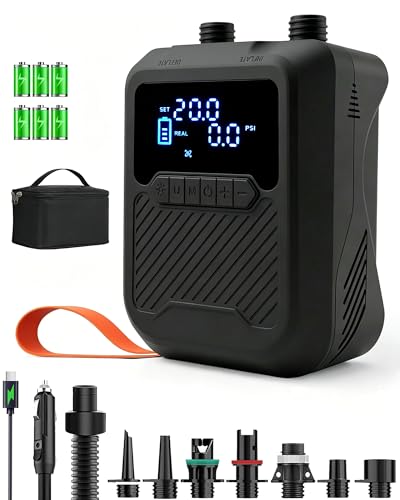
- 13500mAh rechargeable battery
- Dual-stage inflation system
- LCD, cooling, and emergency light
Best For: Multiple-board outings with rechargeable power
Best High-Capacity Pick – 50PSI Rechargeable SUP Pump
For beginners comparing paddleboard pumps for beginners, this rechargeable model combines preset-pressure control, automatic shutoff, and both inflation and deflation. Its 12,000mAh battery can handle up to four paddleboards at 12 PSI per charge, while 12V vehicle power provides a backup.
Best For: Families, group outings, and users who want extended cordless operation.
Pros:
- Large 12,000mAh battery supports up to four boards at 12 PSI.
- Three-stage inflation reaches 12 PSI in 8.5 minutes or less.
- Active cooling supports repeated inflation and deflation.
- LED display, built-in light, carrying bag, and 2.9-pound design improve portability.
Cons:
- Its maximum pressure is much higher than most SUP applications require, which may be unnecessary for some beginners.
- Charging and battery status details beyond the supplied capacity are not specified.
This is a versatile choice when battery endurance matters most. The automatic pressure control and clear display make it approachable for beginners, while vehicle-power support adds flexibility for longer trips.
Best All-Around Pick – Seesii 20PSI Cordless SUP Pump
The Seesii is a practical option for beginners shopping for paddleboard pumps for beginners because it offers cordless operation, preset pressure, automatic shutoff, and a readable LCD screen. Its dual-power design lets you use the 6,000mAh battery outdoors or connect to a 12V vehicle supply.
Best For: Travelers and families who want one pump for SUPs, kayaks, floats, and other inflatables.
Pros:
- Battery supports up to four standard SUPs at 12 PSI or two at 15 PSI.
- Two-stage system reaches 12 PSI on a 10.6-foot SUP in about 7.5 minutes.
- Automatic shutoff and LCD pressure display support consistent inflation.
- Includes inflation and deflation modes, three adapters, storage, and a carry handle.
Cons:
- At 5.5 pounds, it is heavier than several compact rechargeable options.
- The battery takes about three hours to charge.
With its broad accessory coverage and dual-power flexibility, the Seesii is a strong general-purpose choice. Beginners may especially appreciate the pressure readout and automatic stopping feature.
Best Lightweight Pick – Hydrohero 20PSI Rechargeable Pump
For beginners looking for paddleboard pumps for beginners that are easy to carry, the Hydrohero stands out at about 2.5 pounds. It uses dual-stage inflation, automatic shutoff, a digital pressure display, and a rechargeable battery that can inflate three 10.5-foot SUPs to 12 PSI per full charge.
Best For: Solo paddlers who prioritize low weight, quick setup, and cordless convenience.
Pros:
- Inflates a 10.5-foot SUP to 12 PSI in about five minutes.
- Lightweight 2.5-pound body includes a built-in handle and waterproof bag.
- Three operating modes and automatic shutoff simplify pressure control.
- Includes seven nozzles and supports inflation and deflation.
Cons:
- The full package does not include a charging plug.
- Battery capacity is limited to three 10.5-foot boards at 12 PSI per charge.
The Hydrohero offers an appealing balance of speed and portability. Its compact design is especially useful when carrying gear to the launch point, while the digital controls reduce guesswork for first-time users.
Best Budget Vehicle-Powered Pick – 20PSI Car-Connector SUP Pump
If you are choosing paddleboard pumps for beginners and usually launch near your vehicle, this corded electric model keeps operation simple. It connects to a car cigarette lighter, includes a long 3.4-meter power cord, and uses an LCD display to show current pressure during inflation.
Best For: Car-based launches and beginners who do not need a rechargeable battery.
Pros:
- 20 PSI maximum pressure suits paddleboards and other inflatables.
- Automatic inflation and deflation reduce manual effort.
- LCD pressure display helps monitor inflation in real time.
- Six adapters support paddleboards, mats, floating pads, and other products.
Cons:
- It requires a 12V car connection and cannot operate cordless.
- At 4 pounds, it is heavier than the Hydrohero model.
- Inflation typically takes 10–15 minutes for a regular SUP.
This pump is a straightforward choice when vehicle access is reliable. It gives beginners useful pressure feedback and broad adapter compatibility without requiring battery management, but it is less flexible away from a car.
Best Cordless Pick – TOPUMP Rechargeable SUP Pump
For beginners comparing paddleboard pumps for beginners, the TOPUMP is a convenient cordless option. Its rechargeable battery can inflate up to three 10.6-foot SUPs from 0 to 12 PSI per charge, while the dual-stage motor reaches 12 PSI in about five minutes.
Best For: Beginners who want portable, hands-free inflation away from a car outlet.
Pros:
- Cordless, rechargeable design weighs about 1.1 kg.
- Preset pressure and automatic shut-off help prevent over-inflation.
- Includes seven nozzles for SUPs, boats, kayaks, tents, and more.
- Offers one-touch deflation and a two-year manufacturer warranty.
Cons:
- Requires charging before use.
- Its maximum pressure is 20 PSI, so users should confirm their board’s pressure requirement.
The TOPUMP stands out when portability and simplicity matter most. It is especially practical for beach or lakeside setups where access to a vehicle power outlet is limited.
Best Manual Option – SUP Hand Pump Max 27 PSI
Beginners looking at paddleboard pumps for beginners may prefer this straightforward hand pump when they want a lightweight backup with no battery or vehicle connection. It has a 2,200-cubic-centimeter capacity, a built-in pressure gauge, and a maximum rating of 27.5 PSI.
Best For: Beginners who want a simple manual pump for boards and inflatable boats.
Pros:
- Manual operation avoids batteries and electrical connections.
- Built-in pressure gauge supports more controlled inflation.
- Lightweight aluminum shaft is designed for portability and reliability.
- Includes a 4.5-foot hose with an HR adapter for common valve types.
Cons:
- Manual inflation requires more physical effort than an electric pump.
- Inflation speed can vary with the user’s pumping pace.
This is a practical choice for users who value simplicity and dependable portability. Its higher pressure rating and broad valve compatibility also make it useful as a backup pump.
Best Car-Powered Pick – GICLE 12V Electric SUP Pump
For beginners choosing paddleboard pumps for beginners, the GICLE offers quick inflation from a vehicle’s 12V outlet. Its dual motors can inflate a board to 12 PSI in about six minutes, and the LCD display shows pressure while the automatic shut-off handles the preset target.
Best For: Beginners who inflate near their vehicle and want electric speed without manual pumping.
Pros:
- Dual motors inflate to 12 PSI in approximately six minutes.
- LCD pressure display provides real-time monitoring.
- Automatic shut-off stops at the selected pressure.
- Includes multiple nozzles for SUPs, boats, kayaks, mattresses, and other inflatables.
Cons:
- Requires a 12V car power connection.
- At about 3.4 pounds, it is heavier than the TOPUMP cordless model.
- Has a 30-day warranty description.
The GICLE is a useful middle ground for drive-up launches: it provides fast, monitored inflation while avoiding the effort of a hand pump. It is less suitable for remote locations without vehicle access.
Best with Extra Features – Rechargeable 20 PSI SUP Pump
For beginners comparing paddleboard pumps for beginners, this cordless electric model keeps setup simple with preset modes, a large LED display, and automatic shutoff. Its rechargeable battery, USB-C charging, and included car adapter provide flexible power for beach or lake trips.
Best For: Beginners who want a portable pump with cordless convenience and straightforward controls.
Pros:
- 12000mAh battery can inflate and deflate up to three boards from 0–15 PSI on one charge, according to the supplied details.
- Large display shows current and target pressure, while four modes support boards, air mattresses, free use, and blower tasks.
- Includes USB-C charging, a 12V DC cable, hose, and seven interchangeable nozzles.
Cons:
- At 2.61 pounds, it is portable but not the lightest option.
- Its maximum pressure is 20 PSI, so the extra capacity may be unnecessary for lower-pressure inflatables.
This is a beginner-friendly choice when portability and multiple power options matter more than the simplest corded setup.
Best Multi-Use Value – 50 PSI Car-Powered SUP Pump
Among paddleboard pumps for beginners, this 12V electric model stands out for its broad pressure range and simple preset controls. It plugs into a car cigarette lighter, automatically stops at the selected pressure, and can also handle tires and other inflatables.
Best For: Beginners who want one car-powered pump for paddleboards, tires, kayaks, and general outdoor use.
Pros:
- Supports up to 50 PSI and reportedly inflates a 10.6-foot board to 12 PSI in about six minutes.
- SUP, car-tire, and deflation modes make the pump versatile.
- Large LED display, auto-off protection, 10-foot power cable, and eight adapters add convenience.
Cons:
- Requires a 12V DC car cigarette lighter socket rather than a rechargeable battery.
- The higher-pressure design may be more capability than a beginner needs for SUP-only use.
Choose this model if you usually transport your board by car and value versatility, especially the ability to inflate tires and other gear with the same pump.
Best Battery Capacity – Dual-Stage 20 PSI Paddleboard Pump
For beginners shopping paddleboard pumps for beginners, this dual-stage model offers automatic inflation with a rechargeable battery and 12V car power option. Its LCD controls, preset pressure settings, and cooling system help make repeated board setup more manageable.
Best For: Beginners and families who need enough battery capacity to inflate several boards during an outing.
Pros:
- The 13500mAh battery is rated to inflate three SUPs to 15 PSI or four to 12 PSI.
- Dual-stage inflation is specified at 360L/min for the first stage and 100L/min for the second stage.
- LCD monitoring, auto shutoff, cooling, and a built-in emergency light support convenient outdoor use.
Cons:
- Full battery charging takes approximately four to five hours.
- Deflation must be stopped manually rather than shutting off automatically.
- The supplied test time is about 11 minutes to reach 15 PSI on a 10-foot-6-inch board, so inflation is not instant.
This pump is a practical fit when battery endurance and dual power matter, provided you can plan ahead for charging and do not mind manual deflation control.
How We Picked These Paddleboard Pumps for Beginners
We selected models that cover the main needs of new paddlers: simple operation, compatibility with common inflatable SUP valves, useful pressure control, and reasonable portability. The lineup includes cordless rechargeable pumps, 12V car-powered options, dual-stage electric pumps, and a manual pump for users who want a low-cost backup or do not want to rely on a battery.
We also considered features that reduce guesswork, including digital or automatic shutoff, built-in deflation, multiple adapters, and pressure ratings up to 20 or 50 PSI. A higher stated PSI does not automatically mean faster inflation, so buyers should still check the pump’s airflow, duty cycle, and compatibility with their board.
Quick Comparison
| Pump type | Best for | Main advantage | Potential trade-off |
|---|---|---|---|
| Cordless electric | Convenient beach or campsite setup | No car outlet or long cable required | Needs charging and may have limited runtime |
| 12V electric | Road trips and frequent use | Consistent power from a vehicle | Must stay near the car or a suitable power source |
| Dual-stage electric | Faster, easier inflation | High airflow at low pressure, then high-pressure finishing | Can be louder and bulkier |
| Manual hand pump | Backup use and simple storage | No battery, outlet, or motor required | More physical effort and slower setup |
Key Buying Factors for Paddleboard Pumps for Beginners
Pressure and Valve Compatibility
Most inflatable SUPs require a high-pressure pump with a compatible valve adapter. Confirm the pump supports your board’s valve before buying. A pressure range around 15 to 20 PSI is common for paddleboards, while a 50 PSI rating can provide extra headroom but is not necessary for every board.
Power Source and Portability
Rechargeable pumps are convenient when you launch away from your vehicle, while 12V models are useful for drive-to-the-water trips and repeated inflation. Consider battery runtime, charging time, cable length, and overall weight. A manual pump is worth keeping as an emergency backup even if you primarily use an electric model.
Automatic Shutoff and Controls
Automatic shutoff helps prevent overinflation and lets you handle other setup tasks. A clear pressure display or simple controls are especially helpful for beginners. Dual-stage inflation can reduce the time spent filling a large board, while deflation makes packing easier.
Noise, Heat, and Included Accessories
Electric pumps can be noisy and may need cooling breaks during extended use. Check the recommended duty cycle and included nozzle set. Multiple adapters are useful if you also inflate kayaks, boats, or other gear.
Who Should Buy Which Paddleboard Pumps for Beginners?
Choose a cordless rechargeable pump if you value freedom from a vehicle and usually inflate one or two boards. Pick a 12V car pump for dependable power during road trips or frequent sessions near a parking area. A dual-stage electric model is the best fit when reducing setup time matters most. If your priority is reliability, low cost, or emergency preparedness, choose the manual hand pump and keep it accessible on every outing.
For most first-time paddlers, the best option is the model that matches both your board’s required PSI and your launch location. Verify valve fit, review the power requirements, and choose automatic shutoff when you want the simplest inflation experience.