When you are far from cell service, a dependable handheld GPS can make navigation safer and less stressful. The best models combine accurate positioning, a readable display, rugged construction, and enough battery life for extended trips.
We selected 10 handheld GPS devices with long battery life, ranging from simple button-operated navigators to advanced models with expanded satellite support, electronic compasses, and color mapping.
Best 10 Handheld Gps Devices with Long Battery Life Picks for 2026
Solar-Powered Pick

- Up to 200 hours without solar charging
- Solar charging can provide unlimited battery life in sunlight
- Multiband GPS and IPX7 water resistance
Best For: Sunny hikes and extended outdoor trips
Accuracy-Focused Navigator

- Multiband and expanded GNSS support
- 2.6-inch sunlight-readable color screen
- Includes routable TopoActive maps
Best For: Challenging terrain and accuracy-focused navigation
Extended Expedition Choice

- Up to 1,800 hours in expedition mode
- Replaceable AA battery design
- Multi-GNSS support and IPX7 water resistance
Best For: Long trips and situations where recharging is limited
Large-Screen Value Option

- 3.2-inch sunlight-readable display
- Up to 36 hours per charge with USB-C
- USA Topo maps and 32 GB storage
Best For: Hikers wanting a larger screen and included USA mapping
Best Budget Pick

- Up to 20 hours on two AA batteries
- IPX7 waterproof and rugged design
- GPS, GLONASS, and paperless geocaching support
Best For: Simple hiking, running, and geocaching navigation
Longest Battery Runtime

- Up to 36 hours of battery life
- 3.2-inch sun-readable color display
- 64 GB storage with USA Topo maps
Best For: Extended hikes, camping trips, and overnight navigation
Best Mapping Features

- Up to 20 hours of battery life
- Built-in U.S. topographic data
- Color screen, compass, and barometric altimeter
Best For: Terrain-focused hiking and outdoor navigation
Reliable Trail Companion

- Up to 25 hours with two AA batteries
- Sunlight-readable 2.2-inch color display
- Preloaded routable TopoActive maps
Best For: Hikers and cyclists who prefer simple AA-powered navigation
Elevated Terrain Navigation

- Up to 25 hours with two AA batteries
- Adds a 3-axis compass and barometric altimeter
- Includes TopoActive maps and expandable storage
Best For: Hikers needing compass and elevation data in a replaceable-battery GPS
Ultra-Endurance Touchscreen Navigator
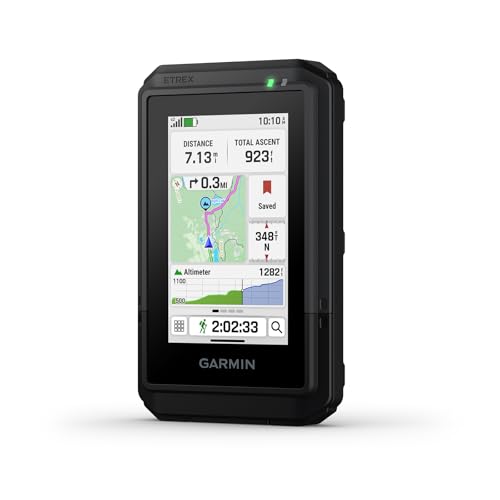
- Up to 130 hours of standard use or 650 hours in expedition mode
- Bright 3-inch touchscreen with preloaded maps
- IP67-rated with multi-band GPS support
Best For: Extended trips requiring touchscreen navigation and maximum battery endurance
Solar-Powered Pick – Garmin eTrex Solar
The Garmin eTrex Solar is a strong choice among handheld GPS devices with long battery life, especially for sunny hikes and extended outdoor trips. Its solar charging, multiband GPS, and compact button-operated design cover essential navigation needs without adding much weight.
Best For: Hikers and campers who want exceptionally long runtime with solar charging.
Pros:
- Up to 200 hours without solar charging, or unlimited battery life in suitable sunny conditions.
- Multiband GPS supports improved positional accuracy.
- IPX7 water resistance and a sunlight-readable 2.2-inch display.
- Digital compass works even when stationary.
Cons:
- Solar performance depends on sufficiently bright conditions.
- The 2.2-inch screen is smaller than some competing handheld units.
- Mapping and software features require pairing with a compatible smartphone.
Choose this model when battery endurance is the priority and your trips frequently include reliable sunlight. It is particularly appealing for lightweight backcountry navigation and geocaching.
Accuracy-Focused Navigator – Garmin GPSMAP 65
The Garmin GPSMAP 65 is a practical option for shoppers comparing handheld GPS devices with long battery life and strong reception in difficult terrain. Its expanded GNSS support, multiband technology, and sunlight-readable color display are designed for challenging locations such as forests, steep country, and urban canyons.
Best For: Outdoor users who prioritize positional accuracy and built-in mapping.
Pros:
- Expanded GNSS and multiband technology support accurate positioning in challenging areas.
- Large 2.6-inch sunlight-readable color display.
- Includes routable TopoActive mapping and U.S. federal public land maps.
- Works with the Garmin Explore app and website for managing routes, tracks, and waypoints.
Cons:
- Battery life is up to 16 hours, considerably less than several long-runtime models.
- Advanced app features require a compatible smartphone.
- Its button-operated interface may be less convenient for users who prefer touch controls.
The GPSMAP 65 is better suited to accuracy-first navigation than maximum battery endurance. It makes sense for users who regularly navigate under tree cover or among buildings and want mapping included.
Extended Expedition Choice – Garmin eTrex SE
The Garmin eTrex SE stands out among handheld GPS devices with long battery life because it combines replaceable AA batteries with an expedition mode rated for up to 1,800 hours. It also adds multi-GNSS support, a sunlight-readable display, and wireless connectivity for planning and updates through Garmin Explore.
Best For: Extended trips where replaceable batteries and expedition runtime matter most.
Pros:
- Up to 168 hours in standard mode and up to 1,800 hours in expedition mode.
- Uses two field-replaceable AA batteries, which are not included.
- Multi-GNSS support includes GPS, GLONASS, Galileo, BeiDou, and QZSS.
- IPX7 water resistance and a digital compass that works while stationary.
Cons:
- AA batteries must be purchased separately.
- Expedition mode may provide fewer active features than standard mode.
- Mapping, weather, and wireless updates require a compatible smartphone.
This is a compelling pick for long-distance hikers, emergency kits, and trips where recharging may be difficult. Its replaceable-battery design offers practical backup flexibility beyond the headline runtime.
Large-Screen Value Option – NiesahYan Handheld GPS
This NiesahYan navigator offers a straightforward alternative for shoppers seeking handheld GPS devices with long battery life and a larger display. It pairs a 3.2-inch sunlight-readable screen with USA Topo maps, multi-GNSS support, a rechargeable USB-C battery, and a rugged IP66 water-resistant design.
Best For: Hikers who want a larger screen, preloaded USA maps, and rechargeable convenience.
Pros:
- 3.2-inch sunlight-readable screen with physical buttons.
- Up to 36 hours of battery life per charge and USB-C recharging.
- Includes USA Topo maps and 32 GB of internal storage for map downloads.
- Combines multi-GNSS support with a 3-axis compass and barometric altimeter.
Cons:
- Its 36-hour runtime is shorter than the Garmin eTrex models in this roundup.
- IP66 water resistance is specified rather than the higher IPX7 rating found on some alternatives.
- The supplied notes do not indicate smartphone connectivity or wireless updates.
Consider this model if screen size and included USA mapping are more important than maximum battery endurance. The rechargeable battery and USB-C cable also make routine charging convenient for shorter outings.
Best Budget Pick – Garmin eTrex 10
For shoppers seeking handheld GPS devices with long battery life, the Garmin eTrex 10 is a compact, straightforward option. It combines a rugged, IPX7-rated design with a monochrome 2.2-inch display, worldwide basemap, and up to 20 hours of operation from two AA batteries.
Best For: Budget-conscious hikers, runners, and geocachers who prefer simple button-based navigation and replaceable batteries.
Pros:
- Runs for up to 20 hours on two AA batteries.
- Supports GPS, WAAS, HotFix, and GLONASS for reliable positioning.
- IPX7 waterproofing, paperless geocaching, and worldwide basemap add outdoor versatility.
Cons:
- The 2.2-inch monochrome screen is more basic than a color display.
- Only 6 MB of storage is listed.
- Supplied mapping and features are less extensive than those of more advanced handheld GPS units.
The eTrex 10 is a sensible choice when dependable basic navigation and battery flexibility matter more than a large screen or extensive map storage.
Longest Battery Runtime – YuisyNie S190 GPS Navigator
The YuisyNie S190 stands out among handheld GPS devices with long battery life, offering a stated 36 hours of runtime for extended hikes and overnight trips. It also adds a 3.2-inch sun-readable color display, USA Topo maps, multi-GNSS support, and 64 GB of storage.
Best For: Hikers and campers who want extended runtime, a color screen, route backtracking, and substantial map-storage capacity.
Pros:
- Rated for up to 36 hours of battery life.
- Includes a 3-axis compass, barometric altimeter, and TrackBack route guidance.
- Offers USA Topo maps, a worldwide basemap, and 64 GB of internal memory.
- Supports GPS, Galileo, QZSS, and BeiDou satellite systems.
Cons:
- The supplied map zoom tier may show a blank map when zoomed in too far until higher-detail files are downloaded.
- Its IP66 rating is not the same as full waterproofing.
- The 6.9-inch listed length makes it less compact than the Garmin models here.
The S190 is the strongest runtime-focused pick in this group, particularly for longer trips where color mapping, storage, and navigation sensors are useful.
Best Mapping Features – Garmin GPSMAP 62St
The Garmin GPSMAP 62St is a rugged choice for buyers comparing handheld GPS devices with long battery life and richer terrain information. Its 2.6-inch sunlight-readable color screen, built-in U.S. topographic data, electronic compass, and barometric altimeter support more detailed outdoor navigation, while two batteries provide up to 20 hours of use.
Best For: Outdoor users who want topographic mapping, terrain tools, and a durable, waterproof Garmin handheld.
Pros:
- Provides up to 20 hours of battery life.
- Includes 100K U.S. topographic data and a worldwide basemap with shaded relief.
- Features a sunlight-readable 2.6-inch color display, tilt-compensated compass, and barometric altimeter.
- Supports custom maps, additional map types, and optional BirdsEye Satellite Imagery.
Cons:
- BirdsEye Satellite Imagery requires a subscription.
- The 20-hour runtime is shorter than the S190’s stated 36 hours.
- The model is an older design with a 2010 model year listed.
The GPSMAP 62St is a good fit when built-in topographic data and terrain-reading tools are more important than achieving the longest runtime available.
Reliable Trail Companion – Garmin eTrex 22x
The Garmin eTrex 22x is a practical choice among handheld GPS devices with long battery life, offering up to 25 hours of GPS use from two AA batteries. Its compact, rugged design, sunlight-readable color screen, and preloaded routable maps make it well suited to everyday hiking and cycling navigation.
Best For: Hikers, cyclists, and campers who want dependable button-based navigation with replaceable batteries.
Pros:
- Up to 25 hours of battery life in GPS mode with two AA batteries
- Sunlight-readable 2.2-inch color display with 240 x 320 resolution
- Preloaded TopoActive maps include routable roads and trails
- Supports both GPS and GLONASS satellite systems
Cons:
- Uses a small 2.2-inch display
- No touchscreen; navigation relies on buttons
- The supplied notes do not specify included premium map content beyond the preloaded maps
The eTrex 22x is a straightforward, battery-friendly navigator for users who value simplicity and easy AA battery replacement over touchscreen features.
Elevated Terrain Navigation – Garmin eTrex 32x
The Garmin eTrex 32x combines up to 25 hours of GPS battery life with a rugged handheld format and preloaded TopoActive maps. It adds a 3-axis compass and barometric altimeter to the eTrex platform, giving hikers and outdoor users more useful orientation and elevation information.
Best For: Outdoor users who want replaceable-battery navigation plus compass and elevation features.
Pros:
- Up to 25 hours of GPS use with two AA batteries
- Includes a 3-axis compass and barometric altimeter
- Preloaded maps show routable roads and trails for cycling and hiking
- 8 GB of internal storage plus a microSD card slot
Cons:
- Small 2.2-inch display may feel limited for detailed map viewing
- The supplied notes contain conflicting input details, so shoppers should verify interface specifications
- Battery life is shorter than newer rechargeable models designed for extended expeditions
The eTrex 32x is a strong fit when a traditional AA-powered GPS needs to provide more than basic positioning, particularly for routes involving elevation changes.
Ultra-Endurance Touchscreen Navigator – Garmin eTrex Touch
For shoppers comparing handheld GPS devices with long battery life, the Garmin eTrex Touch stands out with up to 130 hours in all satellite systems plus multi-band mode and up to 650 hours in expedition mode. It pairs that endurance with a bright 3-inch touchscreen, preloaded road and trail maps, multi-band positioning, and USB-C recharging.
Best For: Long-distance outdoor trips and users who want touchscreen route planning with exceptionally extended battery modes.
Pros:
- Up to 130 hours in all satellite systems plus multi-band mode, or 650 hours in expedition mode
- Bright 3-inch high-resolution capacitive touchscreen
- IP67 water rating and multi-band GPS support
- Preloaded detailed maps plus Garmin Explore app compatibility
Cons:
- Rechargeable battery requires access to USB-C charging rather than replaceable AA batteries
- Premium Outdoor Maps+ content requires a separate plan
- Touchscreen operation may be less convenient with wet or gloved hands
The eTrex Touch is the clear endurance option in this group, especially for users who want modern touchscreen mapping and can plan around rechargeable power instead of carrying spare AA batteries.
How We Picked the Best Handheld Gps Devices with Long Battery Life
We focused on handheld GPS units suited to hiking, hunting, camping, travel, and other outdoor activities where phone coverage may be unreliable. Our comparison considers battery runtime, navigation features, satellite support, screen usability, durability, controls, mapping, and overall practicality.
Because battery performance depends on settings, temperature, satellite conditions, and usage, treat stated runtimes as estimates. Devices that use replaceable AA batteries can be especially useful on extended trips, while rechargeable or solar-capable models may reduce the need to carry spares.
Quick Comparison
| Best For | Look For | Typical Advantage |
|---|---|---|
| Simple navigation | Basic waypoint and track tools | Easy operation and lower cost |
| Frequent backcountry use | Rugged housing and replaceable batteries | Reliable field serviceability |
| Dense tree cover or steep terrain | Multi-band and expanded satellite support | Improved positioning in difficult conditions |
| Map-based route planning | Color display and preloaded maps | More visual navigation detail |
| Long trips | Extended runtime or solar assistance | Fewer battery changes |
Key Buying Factors for Handheld Gps Devices with Long Battery Life
Battery Type and Runtime
Check whether the unit uses AA batteries, a rechargeable pack, or solar charging. Replaceable batteries are convenient away from outlets, while rechargeable models can be simpler for regular use. Look at runtime with navigation, backlighting, Bluetooth, and other power-hungry features enabled.
Satellite Accuracy
GPS, Galileo, GLONASS, and other satellite systems can improve availability in challenging environments. Multi-band technology may provide faster, more accurate positioning near cliffs, heavy vegetation, or buildings, although it can increase power consumption.
Screen and Controls
Color screens make maps easier to interpret, but button-operated models often work well with gloves and consume less power. Prioritize sunlight readability, screen size, menu simplicity, and whether the controls match your typical conditions.
Maps and Navigation Tools
Confirm what maps are included and whether the device supports downloadable topographic maps, routes, tracks, geocaches, waypoints, or turn-by-turn guidance. A basic navigator may be sufficient if you mainly need coordinates and breadcrumb tracking.
Ruggedness and Orientation
For outdoor use, look for water resistance, impact-resistant construction, a lanyard or carabiner attachment point, and an electronic compass. A barometric altimeter can also help track elevation, but it may require calibration for the best results.
Who Should Buy Which Handheld Gps Devices with Long Battery Life?
Choose a basic eTrex-style navigator if you want dependable waypoints and tracks without a complicated interface. A color-screen model is better for users who regularly follow mapped routes or want to view terrain details on the device.
For demanding backcountry navigation, prioritize expanded satellite support, multi-band positioning, and a compass. For multi-day trips, choose one of the Handheld Gps Devices with Long Battery Life that supports replaceable batteries or solar assistance. If you mainly hike near populated areas and already carry a smartphone, a simpler unit may provide an affordable backup without unnecessary features.