Cold-water diving demands more than a comfortable fit. The right fins must deliver reliable thrust while working well with thick exposure protection, heavier gear, and challenging currents.
We compare 10 diving fins for cold water across scuba, freediving, spearfishing, and snorkeling, focusing on blade performance, strap adjustment, buoyancy, durability, and practical comfort.
Best 10 Diving Fins for Cold Water Picks for 2026
Best Travel-Friendly Choice
Mares Avanti 4X Open Heel Fins

- Open heel with bungee straps
- Four-channel blade for thrust
- Mesh bag included
Best For: Traveling recreational divers using booties
Best Rugged Cold-Water Workhorse

- Rugged rubber construction
- Spring straps suit thick gloves
- Short, wide vented blade
Best For: Technical, professional, and harsh-environment diving
Best for Thick Dive Boots
Cressi Frog Plus Open Heel Fins

- Fits 3–7 mm neoprene boots
- Works with hard-sole boots
- 20% larger blade area
Best For: Divers using varied or thick cold-water boots
Best for Shallow-Water Agility

- Shorter 13 cm blade
- Designed for 2.5 mm boots
- Suitable for strong currents
Best For: Shallow-water spearfishing and freediving
Cold-Water Boot Fit
Cressi Origin LD Open-Heel Fins

- Designed for dive boots
- Glove-friendly spring-loaded straps
- Strong thrust with maneuverable control
Best For: Scuba divers using boots in colder water
Soft Long-Blade Choice
Cressi Gara 3000 Freediving Fins

- Soft blades reduce leg effort
- Full-foot pocket fits bare feet or neoprene socks
- Long-blade design for freediving and spearfishing
Best For: Freedivers using neoprene socks or barefoot
Modular Performance Pick

- Interchangeable long blades
- Efficient 29-degree blade angle
- Comfort-focused self-adjusting foot pocket
Best For: Freedivers and spearfishers seeking a fin that can grow with their skills
Cold-Water Scuba Versatility
Cressi Pro Light Open-Heel Fins

- Open heel fits diving boots
- 20% more effective blade surface
- Lightweight design with comfort pocket
Best For: Scuba divers who want a boot-compatible open-heel fin
Advanced Modular Choice
- Accepts multiple interchangeable blade materials
- Designed for intermediate to advanced divers
- Can be worn with neoprene socks
Best For: Experienced freedivers and spearfishers seeking an adaptable long-blade system
Best Travel-Friendly Choice – Mares Avanti 4X Open Heel Fins
For divers comparing diving fins for cold water, the Mares Avanti 4X is a practical open-heel option that can be worn over dive booties. Its bungee straps, heel pad, and four-channel blade balance convenience with propulsion for scuba diving and snorkeling.
Best For: Travelers and recreational divers who want adjustable open-heel fins for cold-water diving and extended snorkeling.
Pros:
- Bungee straps and an anatomical heel pad support quick, secure fitting over booties.
- Four-channel blades are designed to increase thrust while reducing leg fatigue.
- Over-molded side ribs improve stability and control in stronger currents.
- A reusable mesh bag simplifies transport and drying.
Cons:
- At 4.6 pounds per pair, they may not be the lightest travel fins.
- The open-heel design requires compatible booties for a complete cold-water setup.
The Avanti 4X is a versatile choice when fit flexibility and easy packing matter. Its adjustable bungee system makes it especially suitable for divers moving between warm-water travel and colder conditions.
Best Rugged Cold-Water Workhorse – Apeks RK3 Military Rubber Fin
The Apeks RK3 is built for demanding conditions, making it a strong contender among diving fins for cold water. Its rugged rubber construction, short wide blade, and stainless steel spring straps are suited to divers who prioritize durability, maneuverability, and easy handling with gloves.
Best For: Military, professional, public-safety, and recreational divers seeking compact fins for harsh environments and thick gloves.
Pros:
- Ultra-rugged rubber construction is designed for harsh environments.
- Stainless steel spring straps are easier to use with cold hands or thick gloves.
- Short, wide blades provide forward thrust with good maneuverability.
- Vented blades reduce resistance on the upstroke and enhance downstroke thrust.
Cons:
- The 4.7-pound weight may be less convenient for air travel.
- Its compact, wide-blade design may not suit divers seeking long-blade efficiency.
Choose the RK3 when rugged dependability and glove-friendly adjustment are more important than ultralight packing. The vented, short-wide blade is particularly practical for controlled movement in challenging dive environments.
Best for Thick Dive Boots – Cressi Frog Plus Open Heel Fins
The Cressi Frog Plus is a flexible option for shoppers seeking diving fins for cold water because its open-heel foot pocket accommodates 3 mm, 5 mm, and 7 mm neoprene boots, as well as hard-sole boots. Its larger blade area and channeling effect are designed to deliver steady propulsion on both the upstroke and downstroke.
Best For: Cold-water divers who change boot thicknesses or need compatibility with hard-sole dive boots.
Pros:
- Fits a broad range of 3 mm to 7 mm neoprene boots and hard-sole boots.
- The blade has a 20% larger working surface area for increased water movement.
- Channeling supports energy transfer on both the upstroke and downstroke.
- Dual-density techno polymer and silicone-based construction is designed for durability.
Cons:
- The supplied notes do not specify bungee or spring straps for glove-friendly adjustment.
- At 748 g, each fin is not positioned as an ultralight design.
The Frog Plus stands out for boot compatibility, making it easier to tailor your setup to colder water and different footwear. It is a sensible choice for divers who value adaptable fit and consistent propulsion.
Best for Shallow-Water Agility – Seac Talent Semi-Long Fins
The Seac Talent offers a shorter semi-long blade for divers who need agility near shore, rocks, or shallow-water terrain. For diving fins for cold water, its closed liner is designed for use with 2.5 mm neoprene boots, while the technopolymer construction suits freediving, spearfishing, and diving in strong current.
Best For: Shallow-water spearfishers, freedivers, and divers using 2.5 mm neoprene boots.
Pros:
- The 13 cm shorter blade is designed for greater agility in shallow water.
- The closed liner is designed to accommodate 2.5 mm neoprene boots.
- Suitable for freediving, spearfishing, and scuba diving in strong current.
- Available in five sizes and four camouflage colors.
Cons:
- The closed-liner fit offers less adjustment flexibility than an open-heel design.
- Compatibility is specified for 2.5 mm boots rather than thicker cold-water footwear.
- Semi-long blades may provide less leverage than longer freediving fins.
The Talent makes the most sense when maneuverability is the priority, especially around rocks and in shallow water. Divers using thicker boots should verify fit carefully before choosing this closed-liner model.
Cold-Water Boot Fit – Cressi Origin LD Open-Heel Fins
For divers comparing diving fins for cold water, the Cressi Origin LD is a practical choice when thick boots and gloves are part of the setup. Its open-heel design accommodates dive boots, while spring-loaded straps are intended to remain manageable in colder conditions.
Best For: Scuba divers using boots and needing glove-friendly strap adjustment.
Pros:
- Open-heel fit is designed for use with diving boots.
- Spring-loaded straps simplify adjustments while wearing thick gloves.
- Rubber construction provides robust thrust and supports frog kicks and helicopter turns.
- Strap attachment points help with carrying and storage, while the pin design simplifies replacements.
Cons:
- At 1500 g, these are not the lightest fins for travel.
- The open-heel boot-compatible design is less suited to barefoot use.
The Origin LD stands out for cold-water practicality rather than minimal packing size. Its boot compatibility, easy-to-handle straps, and maneuverable thrust make it a strong option for regular scuba use in demanding conditions.
Soft Long-Blade Choice – Cressi Gara 3000 Freediving Fins
The Cressi Gara 3000 takes a different approach to diving fins for cold water, using long, soft blades that reduce muscle effort during extended freediving or spearfishing sessions. Its full-foot pocket can be worn barefoot or with neoprene socks.
Best For: Freedivers and spearfishers who prioritize efficient, low-effort kicking.
Pros:
- Soft long blades transfer power with less strain on the legs.
- Full-foot pockets can accommodate bare feet or neoprene socks.
- Three-material molding adds flexibility around the foot area.
- Made in Italy by Cressi, an established diving-equipment brand.
Cons:
- The full-foot design is less convenient than adjustable open heels for bulky cold-water boots.
- Long blades can be less compact for transport and storage.
- They are designed for freediving, spearfishing, and diving rather than specifically for scuba boots.
The Gara 3000 is best viewed as a soft, efficient long-blade fin for users wearing neoprene socks or going barefoot. If your cold-water setup depends on thick dive boots, an open-heel model may be more practical.
Adjustable Value Option – Open-Heel Channel-Thrust Fins
These adjustable diving fins for cold water combine an open-heel fit with polypropylene and TPR construction. The buckle system is designed for quick adjustment, while channel thrust technology aims to provide efficient propulsion without excessive leg strain.
Best For: Beginner to professional scuba divers seeking adjustable open-heel fins with efficient propulsion.
Pros:
- Open-heel design and adjustable buckles support a flexible fit.
- One-finger-release buckles make disengagement straightforward.
- PP and TPR construction balances lightness, flexibility, and propulsion.
- Includes a mesh bag and carries a lifetime breakage warranty.
Cons:
- The supplied notes do not specifically confirm compatibility with thick cold-water boots.
- A 30-day money-back guarantee provides a shorter return window than some warranties.
- At 1465 g, the pair may add noticeable weight to travel gear.
This model offers a versatile open-heel format and user-friendly buckles for varied scuba experience levels. Verify sizing with your intended cold-water boots before buying, since boot compatibility is not explicitly specified.
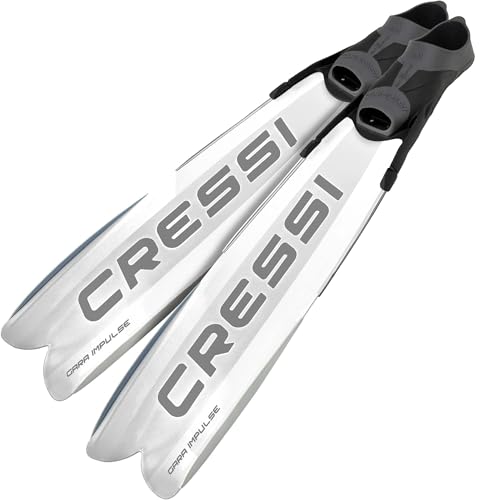
Modular Performance Pick – Cressi Gara Impulse
For divers comparing diving fins for cold water, the Cressi Gara Impulse offers a long-blade freediving design with interchangeable components. Its angled polypropylene blade is built to support efficient kicking, while the full-foot pocket provides a streamlined fit for freediving and spearfishing.
Best For: Freedivers and spearfishers who want a modular fin they can adapt as their skills develop.
Pros:
- Interchangeable Gara Modular blades support different diving needs.
- 29-degree blade angle is designed for efficient kicking with less energy.
- Self-adjusting foot pocket combines comfort with firm power transfer.
- Shock-resistant polypropylene blade includes ribs and a tail shape for control and directionality.
Cons:
- Full-foot design may require careful sizing with thick cold-water socks.
- Long-blade format is more specialized than a general-purpose scuba fin.
The Gara Impulse is a strong choice when modularity and efficient long-blade performance matter most. Check sizing carefully if you plan to use substantial neoprene footwear in cold water.
Cold-Water Scuba Versatility – Cressi Pro Light Open-Heel Fins
The Cressi Pro Light is a practical option for shoppers looking at diving fins for cold water because its open-heel design can accommodate diving boots. The lightweight fin combines a flexible elastomer foot pocket with a blade designed to increase effective surface area and channel water efficiently.
Best For: Scuba divers who need open-heel fins compatible with different diving boots.
Pros:
- Open-heel design pairs with various diving boots.
- Blade starts at the top of the foot for 20% more effective surface area.
- Soft elastomer foot pocket is designed for extended comfort.
- Full-length side rails help direct water for improved thrust.
Cons:
- Shorter, general-purpose design may be less specialized for freediving than a long blade.
- Buckle closure adds hardware compared with a pull-on full-foot fin.
Among these options, the Pro Light is the most straightforward cold-water scuba choice because its open heel works with boots. Its manageable weight and balanced design also suit longer dives and snorkeling sessions.
Advanced Modular Choice – Cressi Gara Impulse Turbo
For experienced divers selecting diving fins for cold water, the Cressi Gara Impulse Turbo combines an angled long blade with a modular system that accepts polypropylene, fiberglass, or carbon-fiber blades. Its wider foot pocket can be worn with neoprene socks, making fit planning especially important for colder conditions.
Best For: Intermediate to advanced freedivers and spearfishers who want interchangeable blade materials and sock compatibility.
Pros:
- Interchangeable blades can be replaced in minutes without modifying the foot pocket.
- Compatible with Cressi polypropylene, fiberglass, and carbon-fiber long blades.
- 29-degree blade angle is designed to improve kick efficiency.
- Includes pre-shaped insoles that can be trimmed for the foot pocket.
Cons:
- Wider foot pocket may require neoprene socks for a proper fit.
- Long-blade freediving design is less suited to divers seeking a compact travel fin.
The Impulse Turbo stands out for advanced users who want a platform that can evolve with different blade materials. For cold water, its sock compatibility is useful, but the wider pocket and insole setup demand careful fitting.
How We Picked the Best Diving Fins for Cold Water
We selected fins that suit the demands of colder environments, where divers may wear thick wetsuits or drysuits and carry more equipment than in warm-water conditions. Our comparison emphasizes thrust, control, foot-pocket comfort, strap security, material durability, and ease of adjustment. The lineup includes rugged rubber military-style fins, open-heel scuba models, semi-long fins, and interchangeable-blade designs for freediving.
Because no single fin is ideal for every diver, we considered how each design balances power, efficiency, maneuverability, weight, and versatility. We also separated models intended primarily for scuba from those better suited to freediving or spearfishing.
Quick Comparison
| Best For | Look For | Most Suitable Design |
|---|---|---|
| Cold-water scuba | Open heel, adjustable straps, firm blade | Heavy-duty rubber or channel fins |
| Strong currents | High thrust and responsive flex | Stiff, powerful paddle or channel blade |
| Travel and warm-to-cold versatility | Lower weight and compact construction | Lightweight open-heel fins |
| Freediving and spearfishing | Long blade and efficient kick cycle | Long-blade composite or plastic fins |
Key Buying Factors for Diving Fins for Cold Water
Fit with Exposure Protection
Check whether the foot pocket accommodates your dive boots. Open-heel fins with adjustable straps are generally the easiest choice for cold-water scuba, especially when boot thickness changes between seasons. A secure heel strap should hold firmly without creating pressure points.
Thrust and Blade Stiffness
Stiffer blades can provide strong propulsion against currents and compensate for bulky equipment, but they may require more leg strength. Softer or longer blades are often more efficient for relaxed, continuous kicking and freediving. Match blade resistance to your technique rather than simply choosing the most powerful option.
Weight, Buoyancy, and Durability
Rubber fins are typically durable and stable in the water, while lighter composite or plastic designs may be easier to transport. Neutrally buoyant fins can help maintain a balanced trim. For shore diving, rocky entries, and frequent use, prioritize reinforced construction and dependable buckles or spring straps.
Straps and Replacement Parts
Spring straps are quick to use and tend to remain secure, while adjustable buckles offer more precise fitting. Before buying, check whether straps, buckles, and blades are replaceable. Modular fins can be especially practical for divers who want to change stiffness or extend the life of the foot pocket.
Who Should Buy Which Diving Fins for Cold Water?
Scuba divers using thick boots or diving in strong current should prioritize open-heel fins with firm blades and robust straps. Divers who value durability and predictable handling may prefer compact rubber designs. Those seeking lighter travel gear should look for streamlined open-heel models with efficient channeling.
Freedivers and spearfishers should focus on long-blade fins, choosing softer blades for efficiency and stiffer interchangeable options for greater power. Beginners should favor a comfortable, forgiving blade over an especially rigid model. If you participate in several disciplines, an adjustable or modular design offers the most flexibility.