The best waterproof compasses help you navigate confidently when trails, weather, and visibility become challenging. This roundup compares 10 practical options, from lightweight orienteering models to rugged military-style lensatic compasses.
We focused on durability, readability, navigation features, portability, and value so you can choose a compass that matches your outdoor experience and intended use.
Best 10 Waterproof Compasses Picks for 2026
Best Lightweight Pick

- Rear sight lens supports precise readings
- Waterproof, shock-resistant metal build
- Glow markings, strap, and pouch included
Best For: Casual hiking, camping, scouting, and beginner navigation
Best Military-Grade Option

- Precision lensatic sighting system
- Waterproof, sandproof, and shockproof
- Rugged aluminum frame made in the USA
Best For: Serious hiking, survival, and tactical navigation
Best Wrist-Mounted Pick
SUUNTO Multifunctional Compass

- Northern-hemisphere two-zone system
- Lightweight wrist-mounted design
- Glove-friendly serrated bezel
Best For: Lightweight hiking and accessible everyday navigation
Best Multi-Function Pick

- Built-in clinometer measures slopes and height
- IP65 waterproof and shakeproof metal build
- Luminous dial, pouch, and lanyard included
Best For: Camping, climbing, geology, and rugged outdoor navigation
Rugged Night-Ready Pick

- Optical eyepiece supports forward and reverse bearings
- Glow-in-the-dark interface aids low-light reading
- Metal and aluminum construction is built for rough conditions
Best For: Night hikes, climbing, biking, and rugged outdoor navigation
Multifunctional Navigation Pick
Eyeskey Military Sighting Compass

- Liquid-filled dial and luminous markings support easy reading
- Includes an inclinometer, sighting line, and rotating bezel
- Rugged waterproof aluminum alloy with pouch and lanyard
Best For: Feature-rich hiking, camping, hunting, and scouting navigation
Lightweight Beginner Pick
TurnOnSport Orienteering Compass
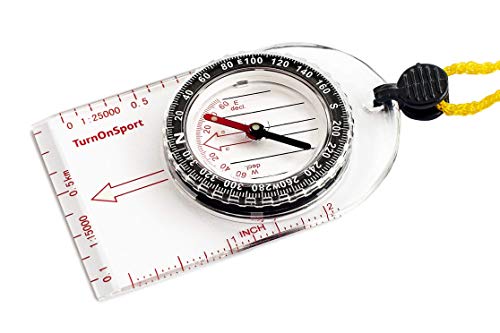
- Weighs just 0.05 kg for easy carrying
- Waterproof acrylic baseplate is suited to outdoor use
- Rotating bezel supports simple map-based navigation
Best For: Kids, scouts, beginners, and casual outdoor activities
Rugged Field Pick
Military Lensatic Sighting Compass
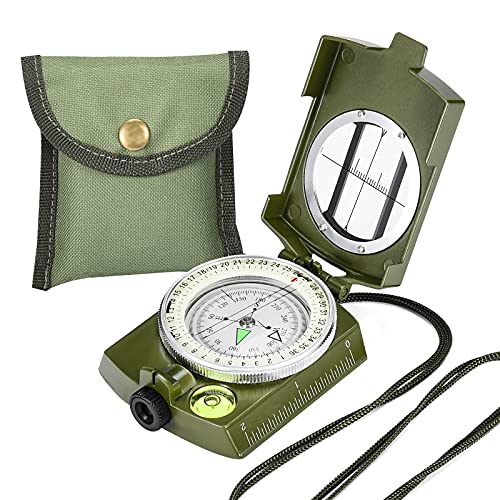
- Waterproof and shakeproof construction
- Bubble level and damping oil support stable readings
- Includes pouch and detachable lanyard
Best For: Demanding hikes, camping, and emergency preparedness
Family Navigation Pick

- Compact, lightweight waterproof design
- Includes map scale and orienting lines
- Magnifying glass supports map reading
Best For: Scouts, beginners, children, and casual hikers
Advanced Terrain Pick
AOFAR AF-4074 Military Compass

- Waterproof and shakeproof metal construction
- Inclinometer and slope chart support terrain work
- Luminous dial and tripod connection add versatility
Best For: Experienced hikers, mapping, geology, and terrain assessment
Best Lightweight Pick – Sportneer Waterproof Compass
For hikers and campers who want practical waterproof compasses, the Sportneer combines a metal construction with a rear sight lens for more precise readings. Its glow-in-the-dark markings, carrying strap, and pouch make it convenient for daytime or low-light navigation.
Best For: Casual hiking, camping, scouting, and beginner outdoor navigation.
Pros:
- Rear sight lens magnifies the dial for more precise readings.
- Waterproof and shock-resistant metal construction.
- Fluorescent markings glow after exposure to light.
- Includes a strap and storage pouch.
Cons:
- May feel slightly heavy for children when worn around the neck.
- Requires a level position for the needle to rotate and read accurately.
- No warranty is listed in the supplied details.
The Sportneer is a well-rounded choice when portability, basic sighting precision, and weather resistance matter more than specialized navigation features.
Best Military-Grade Option – Cammenga Lensatic Compass
Among waterproof compasses, the Cammenga stands out for its precision lensatic sighting system and rugged military-oriented construction. Its aluminum frame is designed for demanding outdoor conditions, while the included waterproof pouch adds protection during transport.
Best For: Serious hikers, survivalists, professionals, and users who prioritize rugged tactical navigation.
Pros:
- Magnifying lens and sighting wire support pinpoint accuracy.
- Waterproof, sandproof, and shockproof design.
- Rugged aluminum frame made in the USA.
- Compact design fits a pocket, backpack, or gear pouch.
Cons:
- Lensatic operation may be more involved than a basic baseplate compass.
- At 7.36 ounces, it is not the lightest option.
- The supplied details do not specify luminous dial performance beyond the product’s phosphorescent design.
Choose the Cammenga if durability and sighting precision are top priorities, especially for rough weather, rugged terrain, or professional-style use.
Best Wrist-Mounted Pick – SUUNTO Multifunctional Compass
The SUUNTO is a compact wrist-mounted option for shoppers seeking lightweight waterproof compasses for northern-hemisphere navigation. Its two-zone system, glove-friendly serrated bezel, and ratchet mechanism provide practical control while moving.
Best For: Lightweight hiking, everyday outdoor navigation, and users who prefer wrist-mounted gear.
Pros:
- Two-zone system is designed for reliable northern-hemisphere readings.
- Wrist-mounted format keeps it readily accessible.
- Serrated bezel can be turned while wearing gloves.
- Lightweight 16-gram construction.
Cons:
- Designed for the northern hemisphere rather than universal use.
- Supplied details do not mention a carrying pouch or illuminated markings.
- The listed dimensions appear larger than expected for a compact wrist compass.
The SUUNTO makes sense for users who value low weight and quick wrist access, provided northern-hemisphere compatibility fits their navigation needs.
Best Multi-Function Pick – Proster Lensatic Compass
For buyers comparing waterproof compasses with added field capability, the Proster pairs lensatic sighting with a built-in clinometer. Its foldable metal lid, luminous dial and arrow, pouch, and lanyard make it suited to demanding camping, hiking, climbing, and exploration.
Best For: Outdoor users who need compass navigation plus slope and height measurements.
Pros:
- Built-in clinometer measures slopes and height.
- Sighting telescope and vertical lubber line support accurate readings.
- IP65 waterproof, shakeproof metal construction.
- Luminous arrow and card support low-light use after light exposure.
Cons:
- At 330 grams, it is considerably heavier than compact compass designs.
- Its multiple controls may require more learning than a basic compass.
- Luminous markings need sufficient sunlight exposure first.
The Proster is a strong fit when a rugged, multifunctional instrument is more useful than minimizing pack weight.
Rugged Night-Ready Pick – Lensatic Survival Compass
For shoppers comparing waterproof compasses, this lensatic model emphasizes durable construction, sighting accuracy, and visibility in low-light conditions. Its metal base and cover, optical eyepiece, bubble level, and glow-in-the-dark interface make it suited to demanding outdoor use.
Best For: Hikers, climbers, cyclists, and explorers who want a rugged compass with nighttime readability.
Pros:
- Optical eyepiece and reversed 360-degree scale support quick forward and reverse bearings.
- Glow-in-the-dark interface improves readability in low-light or dark conditions.
- Rugged aluminum construction with a metal base and cover is designed for weather-resistant outdoor use.
- Includes a bubble level, prism lens, and clear scales for precise readings.
Cons:
- At 0.18 kg, it is heavier than a simple plastic map compass.
- Its lensatic design may offer more functionality than casual users need.
This is a strong choice when durability, sighting capability, and nighttime navigation matter more than ultralight weight.
Multifunctional Navigation Pick – Eyeskey Military Sighting Compass
Among waterproof compasses, the Eyeskey EK-22JG stands out for its multifunction design and rugged aluminum-alloy body. A liquid-filled dial, inclinometer, sighting line, luminous markings, and tripod-mount capability give it broad utility for navigation and outdoor orientation.
Best For: Hikers, campers, hunters, and scouts who want a feature-rich sighting compass with carrying accessories.
Pros:
- Liquid-filled compass provides reliable directional readings, while luminous markings improve low-light visibility.
- Includes an inclinometer, rotating bezel, measurement conversion chart, and sighting line.
- Waterproof rugged aluminum-alloy construction is designed for demanding outdoor conditions.
- Comes with a canvas pouch, carrying box, lanyard, and tripod-mount option.
Cons:
- The larger feature set may feel complex for users seeking a basic compass.
- Its rugged construction may be less convenient for ultralight packing.
Choose this model if you value added measurement and sighting tools, protective accessories, and a sturdy build for varied outdoor activities.
Lightweight Beginner Pick – TurnOnSport Orienteering Compass
For buyers seeking compact waterproof compasses, the TurnOnSport orienteering model is a lightweight, straightforward option for map-based navigation. Its acrylic baseplate, rotating 360-degree bezel, clear markings, and paracord strap make it approachable for children and adults.
Best For: Beginner hikers, children, scouts, and casual campers who need a lightweight map compass.
Pros:
- Lightweight 0.05 kg design is easy to carry or wear with the included strap.
- Acrylic baseplate is described as durable, portable, waterproof, and fall-resistant.
- Rotating 360-degree bezel and azimuth bearing support route plotting on maps.
- Suitable for hiking, camping, fishing, sailing, scouting, and other outdoor activities.
Cons:
- It lacks the sighting and advanced measurement features found on military-style models.
- Its plastic-style baseplate is aimed at lightweight convenience rather than heavy-duty construction.
This is a practical entry-level pick for simple map navigation, especially when low weight, affordability, and beginner-friendly handling are priorities.
Rugged Field Pick – Military Lensatic Sighting Compass
If you want waterproof compasses for demanding hikes, emergencies, or off-trail navigation, this military-style lensatic model emphasizes durability and readable direction finding. Its liquid damping, bubble level, and fluorescent interface are useful features when conditions are challenging.
Best For: Hikers, campers, and preparedness-minded users who want a rugged lensatic compass with a carrying pouch and lanyard.
Pros:
- Waterproof and shakeproof military construction
- Damping oil and a built-in bubble level support steadier, more accurate readings
- Fluorescent interface helps with nighttime visibility
- Includes a canvas pouch and detachable neck lanyard
Cons:
- Lensatic construction may be more involved than a basic map compass
- The listed dimensions are relatively large for a compact navigation tool
This is a practical choice when toughness and field-ready carry options matter more than minimalist size. The illuminated interface adds useful versatility for low-light trips.
Family Navigation Pick – Mini Orienteering Compass
For shoppers comparing waterproof compasses for map reading, this compact orienteering model offers a straightforward, lightweight design. Its orienting lines, ruler scale, magnifying glass, and lanyard make it suitable for learning navigation and planning routes.
Best For: Scouts, children, beginners, and casual hikers who want a portable compass for map-reading practice.
Pros:
- Waterproof plastic construction in a compact format
- Includes orienting lines and a 1:24000 map scale
- Magnifying glass helps with reading and navigating maps
- Lightweight design includes a lanyard for carrying
Cons:
- Plastic construction may be less rugged than a metal military compass
- Designed for basic navigation rather than advanced sighting features
This compass is a sensible entry-level option for map-reading lessons, family outings, and lightweight gear kits. Its simple layout and bright orange finish can make it approachable for younger users.
Advanced Terrain Pick – AOFAR AF-4074 Military Compass
This AOFAR model stands out among waterproof compasses for users who want more than a basic directional needle. The metal body, floating luminous dial, inclinometer, slope chart, and tripod connection support navigation, terrain assessment, and mapping in varied outdoor conditions.
Best For: Experienced hikers, campers, geology enthusiasts, and users who need slope-measurement and sighting features.
Pros:
- Waterproof, shakeproof zinc construction with a liquid-filled capsule
- Includes an inclinometer and slope chart for terrain assessment
- Features a luminous arrow and dial for low-light visibility
- Offers an adjustable prism lens, magnifier viewer, and tripod mounting
Cons:
- Its many features may be more than casual users need
- Metal construction can be less convenient for ultralight packing
With its expanded terrain and sighting functions, the AF-4074 is better suited to serious outdoor navigation than simple direction checks. The included bag, lanyard, manual, and two-year warranty add practical value.
How We Picked the Best Waterproof Compasses
We evaluated these Waterproof Compasses for the features that matter most in real outdoor use: construction quality, directional accuracy, readability, sighting capability, portability, and weather resistance. We also considered whether each model is better suited to map reading, basic hiking, survival preparation, or more technical navigation.
Product types vary considerably. Orienteering compasses are generally lightweight and quick to use with a map, while lensatic designs emphasize sighting accuracy and rugged construction. Some models also add clinometers, luminous markings, carrying cases, lanyards, or protective covers.
Quick Comparison
| Best For | Look For | Typical Design |
|---|---|---|
| Trail hiking and map reading | Clear baseplate, rotating bezel, lightweight build | Orienteering compass |
| Survival and field use | Metal housing, sighting system, protective cover | Lensatic compass |
| Camping and general preparedness | Water resistance, luminous markings, simple operation | Compact multifunction compass |
| Terrain and geology work | Clinometer and precise sighting features | Military-style compass |
Key Buying Factors for Waterproof Compasses
Water Resistance and Durability
“Waterproof” claims can describe different levels of protection, so check the stated rating and construction details. An IP-rated compass provides a clearer indication of resistance to water and dust. For wet trails, choose a sealed, impact-resistant model with a secure cover or housing.
Readability in Low Light
Luminous or phosphorescent markings make bearings easier to read at dawn, dusk, or in poor weather. Check whether the markings cover the dial, direction-of-travel arrow, and sighting references—not just the cardinal points.
Navigation Style
A transparent baseplate and rotating bezel are useful for orienting maps and plotting bearings. Lensatic compasses can be better for taking a direct sight on a distant landmark, although they may require more practice. If you are new to navigation, prioritize a clear layout and straightforward controls.
Size, Weight, and Accessories
For day hikes, a lightweight compass with a lanyard or case is convenient. Heavier metal models may be preferable for demanding field use but take up more space. Carrying cases, clinometers, sighting wires, and protective covers can add usefulness, but only choose extras you will actually use.
Who Should Buy Which Waterproof Compasses?
Choose a lightweight orienteering compass if you mainly hike, backpack, or practice map-and-compass navigation. These models are typically compact and easy to read.
Choose a lensatic compass if you want a rugged design for survival kits, field exercises, or sighting distant landmarks. Expect a steeper learning curve and a bulkier profile.
Choose a multifunction compass with an inclinometer for camping, geology, route planning, or measuring slopes and angles. These features are useful when terrain assessment matters as much as basic direction.
Whichever style you select, practice using it with a topographic map before relying on it in unfamiliar terrain. A compass is most effective when paired with map-reading skills, local magnetic-declination information, and a backup navigation method.