Not every spotting scope is a good fit for the night sky, but the right one can deliver crisp lunar detail, brighter views, and an easier setup than a full telescope.
This roundup of spotting scopes for stargazing focuses on optical quality, practical zoom ranges, stability, and overall value so you can choose with confidence.
Best 10 Spotting Scopes for Stargazing Picks for 2026
Premium Angled All-Rounder
Celestron Ultima 20-60x80 Angled Spotting Scope

- 80mm objective with 20-60x zoom
- Angled 45° viewing for comfort
- Multi-coated optics with digiscoping support
Best For: Versatile viewing sessions that include stargazing, wildlife, and distant subjects
Value-Focused HD Spotter
Vortex Crossfire HD 12-36x50 Angled

- HD optics with anti-reflective coatings
- Arca-Swiss foot for easy tripod mounting
- Waterproof, fogproof, and lifetime backed
Best For: Portable, value-focused viewing with dependable optics and easy tripod setup
Accessories-Rich Zoom Scope
Gosky Flagship DiamondEdge 20-60x80

- 80mm lens with fully multi-coated optics
- Includes smartphone adapter and tripod
- Waterproof, fog-proof, and nitrogen-filled
Best For: Shoppers who want a complete kit for long-range viewing and phone captures
Large-Aperture Kit Pick
WOSPORTS 85mm 25-75x Spotting Scope

- 85mm lens with 25-75x zoom range
- HD BAK4 prism and multi-coated optics
- Includes tripod, phone adapter, and lifetime warranty
Best For: Viewers who want the largest aperture and highest zoom in a bundled kit
Grab-and-Go Mak Spotter
SVBONY SV41Pro Mak Spotting Scope, 80mm

- Compact 280mm tube and 1.8kg build
- 28-84x zoom with 80mm objective
- Dual-speed focus for lunar and planetary viewing
Best For: Portable lunar and planetary observation with daytime versatility
Balanced All-Rounder

- 25-75x zoom with 80mm objective lens
- BAK4 prism and FMC optics
- Phone holder included for digiscoping
Best For: All-purpose viewing with easy phone-adapter use
Budget-Friendly Starter
M MIXIO 20-60x80 Spotting Scope

- 20-60x zoom with 80mm objective
- Includes tripod, phone adapter, and bag
- BAK4 optics with multi-layer coatings
Best For: Starter kit buyers who want an all-in-one package
Starter-Friendly Zoom Spotter
SVBONY SV28 Angled 25-75x70 Kit
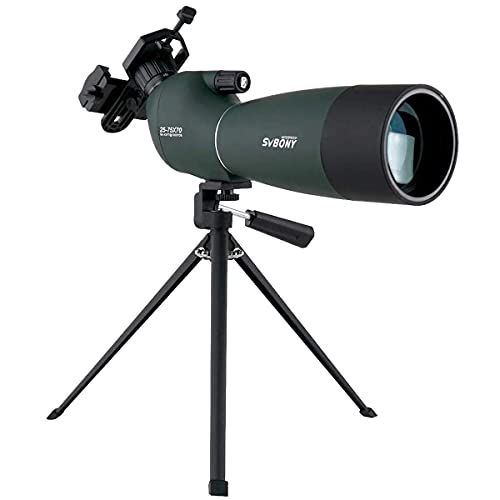
- 25-75x zoom for easy magnification changes
- 70mm lens adds light-gathering ability
- Includes phone adapter, tripod, and case
Best For: Beginners wanting a portable zoom scope for casual stargazing
All-in-One Digital Viewer
GUANIEE 4K Auto-Focus Smart Scope
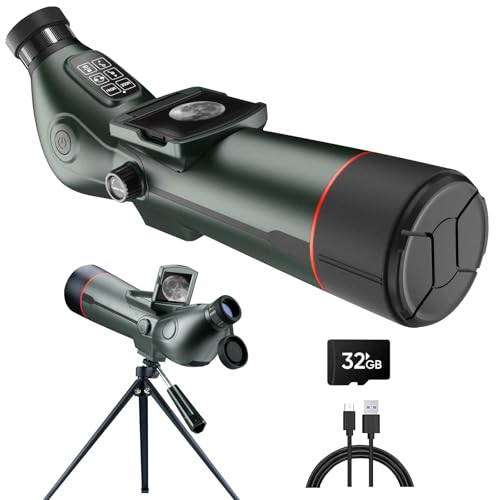
- Built-in display handles viewing and playback
- 4K capture with auto-focus and touch controls
- 80mm aperture and low-light sensor support night use
Best For: Users who want a digital scope with onboard recording and screen viewing
Bright-View Tripod Scope

- 25-75x zoom with manual focus control
- 80mm fully multi-coated lens for brighter views
- Includes full-size tripod, phone adapter, and bag
Best For: People who want a bright, tripod-ready scope with a full accessory bundle
Premium Angled All-Rounder – Celestron Ultima 20-60×80 Angled Spotting Scope
If you want one of the more versatile spotting scopes for stargazing and general long-range viewing, the Celestron Ultima 20-60×80 is built around a bright 80mm objective and a flexible 20-60x zoom. Its angled body and 45° viewing angle make it easier to settle in for extended sessions, while the multi-coated optics help preserve brightness and contrast when light levels drop.
Best For: Buyers who want a bright, angled zoom scope that can handle casual stargazing plus nature and distance viewing.
Pros:
- 80mm objective lens and 20-60x zoom offer strong reach with a versatile viewing range.
- Multi-coated optics are designed to improve brightness, color, and contrast.
- Angled 45° design and large focus dial help make long viewing sessions more comfortable.
- Includes a soft case, tripod mounting plate, eyepiece pouch, lens cloth, and digiscoping-friendly T-adapter.
Cons:
- At 3.6 pounds, it is not the lightest option for frequent transport.
- The highest magnification is useful for detail, but higher zoom can be more demanding on stability.
This is a strong do-it-all choice if you want a scope that balances reach, comfort, and included accessories. The angled eyepiece and big 80mm lens make it especially appealing for steady viewing sessions where brightness matters.
Value-Focused HD Spotter – Vortex Crossfire HD 12-36×50 Angled
The Vortex Crossfire HD is a compact option to consider if you want spotting scopes for stargazing without overcommitting to size or weight. Its HD optical system, anti-reflective coatings, and angled body are aimed at delivering sharp, low-light-friendly views, while the helical focus and adjustable eyecups make setup and fine-tuning straightforward.
Best For: Viewers who want a lighter, value-minded angled spotter with strong optics and easy tripod use.
Pros:
- HD optical system is designed for good resolution, color fidelity, and edge-to-edge sharpness.
- Anti-reflective coatings on all air-to-glass surfaces help improve light transmission.
- Arca-Swiss compatible foot supports quick mounting on many tripods.
- Nitrogen purged, waterproof, fogproof, and backed by a transferable lifetime VIP warranty.
Cons:
- 50mm objective is smaller than larger 80mm-plus models, so it gathers less light overall.
- Lower 12-36x magnification range is more limited for users wanting maximum reach.
This model stands out for buyers who value portability, durability, and straightforward mounting more than sheer aperture. It is a practical pick if you want a solid optical upgrade in a smaller package.
Accessories-Rich Zoom Scope – Gosky Flagship DiamondEdge 20-60×80
The Gosky Flagship DiamondEdge is a practical pick for spotting scopes for stargazing if you want a full kit with a large 80mm objective and a smooth 20-60x zoom. It uses fully multi-coated optics and a BAK4 Porro prism to improve brightness and clarity, and the included smartphone adapter makes it easy to capture what you see.
Best For: Buyers who want a complete zoom scope kit with phone-adapter convenience and strong light-gathering ability.
Pros:
- 80mm fully multi-coated lens and BAK4 prism support brighter, clearer views.
- 20-60x zoom with dynamic focusing gives flexible long-range viewing.
- Waterproof, fog-proof, nitrogen-filled body adds weather protection.
- Includes smartphone adapter, tripod, carrying case, and protective accessories.
Cons:
- It weighs 2.4 pounds before accessories, so it is not the smallest kit.
- The tabletop tripod is useful, but may not match the stability of a full-size field tripod.
For shoppers who want a ready-to-use package, this Gosky bundle is easy to recommend. The combination of a big objective lens, broad zoom range, and included phone adapter makes it especially convenient for sharing views and photos.
Large-Aperture Kit Pick – WOSPORTS 85mm 25-75x Spotting Scope
If you are comparing spotting scopes for stargazing and want a larger aperture, the WOSPORTS 85mm model offers a strong 25-75x zoom range and a fully multi-coated 85mm objective lens. The HD BAK4 Porro prism, central focus system, and twist-up eyecup are all aimed at delivering a brighter, more comfortable viewing experience.
Best For: Users who want maximum zoom reach in a bundled kit with an 85mm objective lens.
Pros:
- 85mm objective lens helps gather more light for brighter viewing.
- 25-75x magnification provides more reach than many entry-level spotters.
- HD BAK4 Porro prism and fully multi-coated optics are designed for clearer detail.
- Includes tripod, smartphone adapter, carry bag, lens covers, cleaning cloth, and lifetime warranty.
Cons:
- At 4.7 pounds, it is the heaviest option in this group.
- High zoom can be more sensitive to tripod stability and careful focusing.
This WOSPORTS kit is built for buyers who want a feature-rich package and a large objective lens in one purchase. It has the most aggressive zoom range here, which makes it appealing when extra reach matters more than compact size.
Grab-and-Go Mak Spotter – SVBONY SV41Pro Mak Spotting Scope, 80mm
If you want spotting scopes for stargazing that can also handle daytime use, the SVBONY SV41Pro stands out for its compact Maksutov-Cassegrain design, 800mm focal length, and 28-84x zoom eyepiece. The 80mm objective lens and FMC coating are aimed at brighter, clearer views, while the dual-speed focus helps you dial in lunar and planetary detail more easily.
Best For: Stargazers who want a compact, lightweight scope that can also double for birding, travel, and digiscoping.
Pros:
- Compact 280mm tube and 1.8kg setup make it easy to carry.
- 28-84x zoom eyepiece offers flexible magnification for distant subjects.
- 80mm objective lens and FMC coating are designed for brighter, clearer images.
- Dual-speed focus helps with fine adjustments on the Moon and planets.
Cons:
- Finderscope base is reserved but the finderscope is not included.
- At this price-and-size class, it is still a manual-focus setup.
- Best suited to lunar and planetary astronomy rather than deep-sky observing.
This is a practical grab-and-go option if you value portability and versatility over a dedicated astronomy telescope. It gives you a straightforward way to explore the Moon and planets while still remaining useful for terrestrial viewing.
Balanced All-Rounder – Gosky 25-75×80 Spotting Scope
For shoppers comparing spotting scopes for stargazing with everyday outdoor use, the Gosky 25-75×80 offers a balanced mix of reach and practicality. Its 25-75x magnification, 80mm objective lens, BAK4 prism system, and FMC optics are built for reliable viewing, and the included phone holder makes it easier to capture what you see.
Best For: Users who want a proven all-round spotting scope for moon viewing, birdwatching, and phone digiscoping.
Pros:
- 25-75x magnification gives a wide range for adjusting detail.
- 80mm objective lens with BAK4 prism and FMC optics supports brighter viewing.
- Integrated phone holder is included for digiscoping.
- Sold over 500,000 units worldwide since 2019, indicating broad market trust.
Cons:
- Heavier than compact grab-and-go options at 4.5 pounds.
- Manual focus means you adjust everything by hand.
- Most of the appeal is in versatility, not astronomy-specific features.
This is a sensible middle-ground pick if you want one scope that can handle several outdoor tasks without getting overly specialized. It is especially attractive if you plan to use the phone adapter alongside casual stargazing.
Budget-Friendly Starter – M MIXIO 20-60×80 Spotting Scope
If you are shopping for spotting scopes for stargazing and want a ready-to-use kit, this M MIXIO model brings a 20-60x zoom range, 80mm objective lens, tripod, phone adapter, and carrying bag in one package. Its BAK4 roof prism optics, multi-layer coated lenses, and built-in sunshade are aimed at improving brightness, sharpness, and comfort during outdoor viewing.
Best For: Buyers who want an accessory-rich starter scope for lunar viewing, travel, and general outdoor observation.
Pros:
- Comes with tripod, phone adapter, carrying bag, and protective caps.
- 20-60x magnification and 80mm objective lens give useful viewing flexibility.
- BAK4 prism optics and multi-layer coatings are designed for brighter, sharper views.
- 360-degree rotatable tripod adds easy positioning for different scenes.
Cons:
- Listed as a general-purpose spotting scope rather than an astronomy-specialist model.
- Manual focus means setup and tracking are fully hands-on.
- Field of view is listed as 1000m, so it is built more for broad outdoor use than detailed long-session astronomy.
This package is appealing if you want a simple starter setup with the main accessories already included. It is a practical choice for casual lunar viewing and general observation without needing to buy extras right away.
Starter-Friendly Zoom Spotter – SVBONY SV28 Angled 25-75×70 Kit
If you want spotting scopes for stargazing with an easy learning curve, the SVBONY SV28 gives you a 25-75x zoom range, a 70mm objective lens, and an angled body that’s comfortable for casual viewing. It’s a practical pick for beginners who also want a lightweight scope they can take on camping trips or use for general nighttime observation.
Best For: Beginners who want a portable, affordable zoom scope with basic stargazing versatility.
Pros:
- 25-75x zoom makes it easy to step through magnification levels.
- 70mm lens is designed to gather plenty of light for a brighter view.
- Includes a phone adapter and portable desktop tripod.
- Lightweight build and carrying case help with travel and camping.
Cons:
- Desktop tripod is better suited to short, simple setups than full-size observing.
- Designed as an entry-level scope, so it’s more basic than higher-end astronomy models.
For stargazing buyers who value convenience over advanced features, the SV28 is an approachable all-in-one kit. Its zoom range, decent light-gathering lens, and included accessories make it easy to start observing without extra gear.
All-in-One Digital Viewer – GUANIEE 4K Auto-Focus Smart Scope
For spotting scopes for stargazing that double as a recording tool, this digital model stands out with a built-in 2.8-inch display, auto-focus, and 4K image capture. The 80mm aperture, 300mm focal length, and Ultra Starlight CMOS sensor are aimed at low-light viewing, while the included tripod, memory card, and rechargeable battery make it easier to use right out of the box.
Best For: Observers who want a digital scope with onboard screen recording and low-light viewing features.
Pros:
- Built-in 2.8-inch screen removes the need for a phone adapter.
- 4K capture, auto-focus, and touch controls support easy recording.
- 80mm aperture and Ultra Starlight CMOS sensor are meant for low-light conditions.
- Includes tripod, 32GB SD card, carrying bag, and rechargeable battery.
Cons:
- Higher-tech design may be more than a simple visual observer needs.
- At 350x claimed magnification, it’s positioned more as a digital viewing system than a basic scope.
If you want a more modern stargazing setup with built-in capture and playback, this scope is built around convenience. The screen, battery, and bundled storage make it a strong option for users who want to observe and record without extra accessories.
Bright-View Tripod Scope – GUANIEE 25-75×80 Spotter Kit
This is a straightforward choice among spotting scopes for stargazing if you want a larger 80mm objective lens and a full-size tripod. The 25-75x magnification range, fully multi-coated optics, and BAK4 roof prism are built to deliver brighter, clearer views, while the angled eyepiece and included accessories make setup more comfortable and flexible.
Best For: Viewers who want a bright, tripod-ready scope with a full accessory bundle.
Pros:
- 25-75x zoom provides a useful range for adjusting detail.
- 80mm fully multi-coated lens is built for brighter, clearer images.
- Full-size tripod adjusts from 18.3" to 59.3" for different viewing positions.
- Includes phone adapter, carrying bag, and protective lens covers.
Cons:
- At 3.46 kg, it is the heaviest option in this group.
- Manual focus means more hands-on adjustment while observing.
For buyers who want a larger, more stable setup, this kit leans into brightness and convenience. The included tripod and accessory set make it a solid pick if you prefer a ready-to-use scope instead of piecing everything together separately.
How We Picked the Best Spotting Scopes for Stargazing
We prioritized models with enough aperture to gather light, useful magnification ranges for the Moon and brighter celestial targets, and tripod support that helps keep high-power views steady. We also looked for optical designs and build features that matter at night, including decent glass quality, manageable weight, and weather resistance.
Quick Comparison
For Spotting Scopes for Stargazing, the best choices usually fall into three groups: compact scopes for portability, 80mm-class models for the best balance of brightness and versatility, and larger-aperture options for users who want more light and don’t mind extra size. Lower magnification often gives a brighter, steadier image, while very high zoom can be useful only when the atmosphere is stable and the mount is solid.
Key Buying Factors for Spotting Scopes for Stargazing
Aperture Matters Most
Objective lens size has a bigger impact on night viewing than extreme zoom. An 80mm or 85mm scope usually offers a better mix of light gathering and portability than smaller 50mm models.
Magnification Should Be Practical
Zoom ranges like 20-60x are commonly useful. Higher ranges can sound appealing, but they often dim the image and make shake more noticeable. For the Moon, clusters, and bright planets, moderate magnification is often the sweet spot.
Tripod Stability Is Essential
High-power viewing becomes frustrating without a stable tripod. Look for a full-size tripod or plan to upgrade the included one if you want steadier views of the night sky.
Optical Design and Comfort
Angled bodies are often easier to use when pointing upward, especially for extended sessions. Good coatings, decent prisms, and smooth focusing also improve the experience when observing in low light.
Extra Features Can Help
Phone adapters, waterproofing, and carrying bags are useful bonuses, but they should not outweigh optical quality and stability. Digital models may appeal if you want screen-based viewing, though they are not the same as a traditional optical scope.
Who Should Buy Which Spotting Scopes for Stargazing?
Choose a smaller, lighter scope if you want a portable option for occasional moon viewing and daytime use. Pick an 80mm or larger model if you want the strongest all-around performance for brighter deep-sky objects and clearer lunar detail. If you value convenience and share views with others, a digital spotting scope may be the easiest to use, while enthusiasts who want better manual control should lean toward a traditional angled optical scope.
In short, the best Spotting Scopes for Stargazing are the ones that balance aperture, stability, and real-world usability rather than chasing the highest zoom number.