The ALLPOWERS VOLIX P300 review comes down to one question: do you need a compact backup battery that is easy to carry, quick to recharge, and simple to trust for small loads?
For campers, apartment dwellers, and anyone who wants a lightweight emergency power source, it makes a strong case.
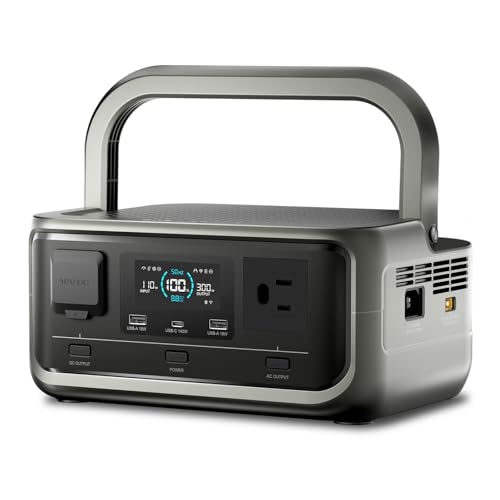
VOLIX P300 Review Summary
The ALLPOWERS VOLIX P300 is best understood as a portable power station for essentials, not a whole-house backup unit.
Its 256Wh LiFePO4 battery, 300W pure sine wave AC output, fast charging options, and built-in UPS behavior make it a sensible fit for people who want reliable everyday portability with enough headroom for laptops, routers, phones, cameras, fans, and similar gear.
Verdict: the VOLIX P300 is a practical, compact choice for light backup and mobile use, especially if you value LiFePO4 longevity and quick recharge times more than raw capacity.
Review Scorecard
| Category | Score | Why it scores this way |
|---|---|---|
| Portability | 9/10 | At 7.87 lbs, it is easy to move between home, car, and campsite. |
| Battery tech | 8/10 | LiFePO4 chemistry and 4,000+ cycles point to long service life. |
| Charging flexibility | 8/10 | AC, solar, and car charging cover most practical use cases. |
| Output versatility | 7/10 | One AC outlet, USB-C, USB-A, and 12V cover common devices well. |
| Backup readiness | 8/10 | <20ms UPS switching is useful for routers and desktop-class gear. |
| Capacity for the size | 6/10 | 256Wh is solid for essentials but limited for larger appliances. |
| Everyday value | 8/10 | The feature set is well matched to portable, not heavy-duty, buyers. |
Key Features and Specifications of VOLIX P300
The VOLIX P300 centers on a 256Wh LiFePO4 battery and 300W pure sine wave AC output, with a 600W surge rating.
That combination makes it suitable for light electronics and small appliances, but not for high-draw devices that need sustained inverter capacity.
Its charging and output layout is straightforward:
- 1 pure sine wave AC outlet
- 1 x 100W USB-C PD port
- 2 USB-A fast-charging ports
- 1 12V car socket
- AC fast charging in as little as 2 hours
- Up to 110W MPPT solar charging support
- Car charging support
The built-in UPS feature is one of the more useful details in the listing.
With automatic switchover under 20ms, the unit is positioned as a backup option for desktop computers, WiFi routers, NAS devices, office electronics, and gaming consoles.
That does not make it a server-room power system, but it does make it more functional than a casual campsite battery.
The physical design is also part of the appeal.
Weighing 7.87 lbs, the unit is light enough to carry for camping, RV travel, fishing, tailgating, van life, and emergency kits.
The included AC charging cable and user manual keep the package simple.
For buyers comparing specifications, the main takeaway is that the VOLIX P300 is built around efficiency and convenience rather than sheer reserve capacity.
Pros and Cons of VOLIX P300
Pros
- Compact and easy to carry for a power station with AC output.
- LiFePO4 battery chemistry suggests better long-term durability than many older lithium setups.
- Fast AC charging is a real convenience when you want the unit ready quickly.
- Solar and car charging support improves its usefulness off-grid and on the road.
- UPS functionality adds value for home backup and workstation protection.
- Clean, quiet power is useful indoors and in shared spaces.
Cons
- 256Wh capacity is limited for buyers expecting extended runtime.
- 300W continuous output excludes many larger appliances and power tools.
- Single AC outlet may feel restrictive if you often use multiple wall-powered devices.
- Best for essentials only if you need true overnight or multi-device base-camp coverage.
Who Should Buy VOLIX P300?
The VOLIX P300 makes sense if you want a compact battery for everyday contingencies.
It suits people who need to keep a router running during a short outage, charge a laptop on the move, power a camera or drone at an event, or handle campsite electronics without the bulk of a larger unit.
It is also a reasonable fit for buyers who care about battery longevity.
The claimed 4,000+ life cycles and LiFePO4 chemistry matter more than flashy specs if you plan to use the unit regularly and keep it for years.
**Buy it if you want a light, flexible power station for essentials.
Skip it if you need long runtime, high-wattage appliances, or a true home backup solution.**
Battery Life, Charging, and Backup Behavior of VOLIX P300
How the 256Wh capacity feels in practice
The 256Wh battery tells you where the VOLIX P300 belongs in the market.
It is not a high-capacity unit built for heavy loads; it is a compact reserve for devices that matter most when the grid goes down or when you are away from an outlet.
That makes it attractive for short sessions of laptop work, phone top-ups, router support, or camera charging.
If your expectation is to run larger appliances for long stretches, the listed capacity is too small.
If your expectation is convenience and mobility, it is easier to justify.
Why the 300W output matters
The 300W pure sine wave AC output is an important boundary.
Pure sine wave output is the safer and more compatible choice for sensitive electronics than rougher inverter designs, and the 600W surge gives brief extra headroom for startup loads.
At the same time, 300W is still a modest ceiling.
That keeps the product focused on phones, tablets, laptops, networking equipment, and similar gear.
Buyers should treat it as a smart essentials unit, not a universal plug-in replacement for wall power.
Fast recharge and solar flexibility
The listing’s strongest convenience feature may be charging speed.
Recharging in as little as 2 hours over AC is useful if you rotate the unit between home use and travel.
The 110W MPPT solar support also gives it a practical role for outdoor use, where charging from the sun can extend usefulness beyond a single outlet.
Car charging support rounds out the setup.
That matters for road trips and emergency kits because it lets the unit travel with you rather than staying tethered to one place.
UPS use for home and desk setups
The built-in UPS function is more than a checkbox feature.
Under-20ms switching is relevant if you want a brief bridge during an outage for a desktop computer, WiFi router, NAS, or console.
It will not replace a dedicated online UPS for every scenario, but it does add real utility for common home-office needs.
For buyers who work remotely or keep critical devices on a desk, this may be the feature that pushes the VOLIX P300 from “nice portable battery” to “useful backup tool.”
Alternatives to VOLIX P300
If you want more capacity, look at the EcoFlow River 2 Max.
It is a natural step up for buyers who want a similarly portable format with more reserve.
If you care about a broad ecosystem and polished portable power products, the Jackery Explorer line is worth comparing.
Jackery often appeals to buyers who want a familiar mainstream option.
If your priority is rugged backup and common-sense sizing, the BLUETTI EB3A is a relevant alternative in the compact power-station category.
For buyers who want a larger step up in runtime, the Anker SOLIX power station line is a practical place to look.
That category is more suitable if the VOLIX P300 feels undersized.
Is VOLIX P300 Worth It?
Yes, if your needs are modest and portability matters more than capacity.
The ALLPOWERS VOLIX P300 is worth considering for camping, road trips, apartments, and light emergency backup because it combines LiFePO4 longevity, fast charging, UPS behavior, and a compact form factor in a straightforward package.
It is less compelling if you want to power large appliances, run equipment for many hours, or serve an entire household through an outage.
In that case, the 256Wh battery and 300W output are simply too small.
For the right buyer, though, the VOLIX P300 is a well-balanced little power station that focuses on the jobs compact backup gear is actually supposed to do.